

Trees Clog Gutters
You bought your home in the suburbs partly because of those mature trees. The shade in summer. The character. The privacy from the street. But if you’ve lived here more than one season, you already know: those same trees are filling your gutters faster than you can keep up with them.
And it’s not just leaves in October. Cottonwoods drop their cotton in late spring. Pines shed needles year-round, not to mention sap. Ash trees release their seeds in dense clusters. If your property has three or four mature trees within 30 feet of your roofline, you’re not cleaning your gutters twice a year — you’re cleaning them four times, or you’re ignoring the problem until water starts overflowing your gutters.
Common Colorado Trees Create Year-Round Gutter Problems
Most gutter systems are designed for moderate leaf drop in fall. They’re not designed for the debris load that mature Front Range trees produce across four seasons. And that’s the issue: Colorado landscapes don’t follow a single-season debris calendar.
Cottonwoods, planted heavily throughout older neighborhoods and along parkways, release their cotton in May and June. Their fluff clogs gutters, sticks to wet shingles, and blocks downspouts completely when it mats together. Then come the leaves in fall. You’re dealing with two separate clog events from one tree.
Pine trees, common in Centennial, Highlands Ranch, and foothills neighborhoods, drop needles constantly. They don’t wait for a season. A mature ponderosa or blue spruce sheds small amounts all year, and those needles are narrow enough to slip through standard gutter screens. They accumulate slowly, then suddenly your downspouts stop draining during a July thunderstorm.
Ash and maple trees, prevalent in Stapleton, Park Hill, and older Aurora subdivisions near Buckley Air Force Base, drop seeds, flowers, and leaves in overlapping cycles. By the time you’ve cleared the spring seed drop, summer storms are knocking down small branches and leaf debris.
What the Numbers Say About Tree Proximity and Gutter Maintenance
Here’s what we see across Colorado: homes with three or more mature trees within 30 feet of the roofline need gutter cleaning four to six times per year to avoid clogs and overflow. At $150 to $300 per cleaning, that’s $600 to $1,800 annually — just in maintenance.
The bigger cost is what happens when you skip a cleaning or two. Foundation water damage in Colorado typically runs $4,000 to $10,000+ to repair. Basement seepage, crawl space moisture, soil erosion around the foundation perimeter — all of it starts with gutters that aren’t moving water away from the house.
Tree debris doesn’t just clog gutters — it holds moisture against your fascia boards and roof edges. In Colorado’s freeze-thaw cycles, that moisture expands, contracts, and accelerates wood rot. We’ve seen fascia replacement projects that cost $3,000 to $5,000, all because cottonwood debris sat in gutters through a wet spring.
And if you’re thinking about climbing a ladder yourself: the average homeowner spends 2-4 hours per cleaning, depending on home size and tree cover. Multiply that by four to six cleanings per year, and you’re looking at a full work week spent on a ladder.
Which Colorado Trees Cause the Most Problems
Cottonwoods: The May-June cotton drop is the worst offender. It clogs gutters completely within days if you’re near a mature tree. Then the fall leaf drop adds a second event. Cottonwoods are everywhere in Colorado, especially in neighborhoods built in the 1970s and 1980s.
Pines (Ponderosa, Austrian, Blue Spruce): Year-round needle drop. Needles are small and slip through mesh screens. They accumulate slowly in corners and downspout elbows, then block drainage during the first heavy rain. Common in Centennial, Highlands Ranch, and foothill areas near Morrison and Evergreen.
Ash Trees: Heavy seed clusters (samaras) in spring, dense leaf drop in fall. Ash trees line many Denver streets and are common in Stapleton and Park Hill. The seeds clog gutters in tight mats.
Maples (Silver Maple, Norway Maple): Spring flowers, summer seed drop, fall leaves. Maples produce three separate debris events and are common in older Denver neighborhoods like Washington Park, Congress Park, and Lowry.
Elms: Less common now due to Dutch elm disease, but still present in older neighborhoods. Heavy leaf drop and small twig shedding during storms.
The Case for Gutter Guards in High-Debris Areas
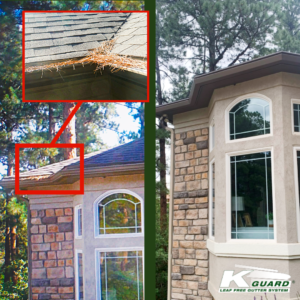
Standard gutter screens and mesh inserts don’t solve the problem. They shift it. Pine needles slip through. Cottonwood cotton mats on top. You’re still cleaning. Now you’re cleaning the screen instead of the gutter. Most homeowners don’t realize standard gutter guards require regular maintenance until they’ve already spent $800 to $1,500 on a screen system that underperforms.
The real question for wooded lots is, can the system handle debris load without any maintenance, or does it just reduce maintenance frequency?
K-Guard’s hooded gutter system is designed to be maintenance free. The curved aluminum hood channels water into the gutter while debris slides off the edge. No mesh to clog. No screen to clean. Cottonwood cotton, pine needles, and ash seeds don’t enter the system. They fall to the ground or blow away.
We’ve installed K-Guard systems on heavily wooded properties where homeowners were cleaning gutters six times a year. After installation, that frequency drops to zero. The system works because it eliminates the entry point for debris, not because it filters debris. Zero maintenance. Period.
Next Steps for Homeowners With Tree Coverage
- Walk your property and count mature trees within 30 feet of your roofline. Three or more trees means you’re in a high-debris zone and likely cleaning gutters four-plus times per year.
- Identify your tree types. Cottonwoods, pines, and ash trees are the highest-risk species for year-round gutter problems. Use this link to help with identification.
- Calculate your annual gutter cleaning costs. Multiply your per-visit cost by your cleaning frequency. If you’re over $600/year, you’re spending enough to justify a permanent solution within 3-5 years.
- Check your fascia boards and foundation perimeter for water damage. Staining on fascia, soil erosion near the foundation, or basement moisture are signs that your current gutters aren’t managing the debris load.
- Evaluate gutter guard systems by debris type, not just price. Mesh and screen systems reduce maintenance for leaf debris, but they don’t eliminate it. Especially for cottonwood cotton and pine needles. Most gutter guard systems will state that they require regular maintenance.
The K-Guard Rocky Mountains Perspective
We’ve installed many gutter systems on wooded lots across Colorado. We see the same pattern: homeowners with mature tree coverage either clean their gutters constantly or they stop cleaning and deal with the consequences later. Likewise, if they installed screens, they’re frustrated with a continued regular cleaning schedule that they thought they were done with. K-Guard eliminates that cycle. The hooded design keeps debris out, and the larger gutter size handles Colorado’s heavy spring runoff and summer storms without overflow. It’s a permanent solution for properties where standard gutters were never going to keep up.
K-Guard Rocky Mountain installs a permanent, maintenance-free gutter system built for Colorado homes. So, if you’re ready to stop climbing that ladder, especially if you’re surrounded by cottonwoods or pines, schedule a free quote with our team. We’ll assess your tree coverage, measure your roofline, and show you exactly how the system performs in high-debris environments.