Gutter Installation in Denver: Sizing, HOA Approval, and What Separates a Good Job From a Cheap One
Gutter installation in Denver seems to be a simple trade. Hang metal, aim it at a downspout, done. Then a thunderstorm drops half an inch of rain in twenty minutes. The trough overflows at the same inside corner it did last summer, and the water lands against a foundation sitting on clay that swells when it gets wet.
Getting the job done right comes down to three things most quotes glaze over: how the system is sized, where the water goes after it leaves the downspout, and who signs off before the work starts.
Denver’s climate is dry…until it is not
Accorder to the 1991–2020 normals, Denver averages a little over 15 inches of precipitation a year at the Stapleton/Central Park station (NOAA NCEI monthly normals). That is desert-adjacent on paper, but it doesn’t account for storm intensity. Colorado’s adopted 2021 plumbing code sizes storm drainage from a 100-year, one-hour rainfall rate, listed as 2.4 inches per hour for Denver (2021 IPC Appendix B).
Snow adds a bigger load for gutters to bear, and it is not spread evenly across the metro. The National Weather Service in Boulder reports about 65 to 70 inches a season in the western and southwestern suburbs. Near Denver International Airport the figure is roughly 47 inches. The office also notes that the official 49-inch average is likely understated, because only one daily observation is taken (NWS Boulder).
| Design input | Value | Why it matters for gutters |
|---|---|---|
| Denver annual precipitation normal (1991–2020) | ~15.4 in | Low total volume; systems still sit dry much of the year |
| Code design rainfall (100-yr, 1-hr) | 2.4 in/hr | Sizing is set by peak intensity, not annual totals |
| Denver seasonal snowfall (official average) | 49 in (likely understated) | Melt-freeze cycling at the eave |
| SW metro suburbs | ~65–70 in | Heavier loads on hangers and fasteners |
| Near DIA | ~47 in | More wind-driven debris and drifting |
Sources: NOAA NCEI; 2021 IPC Appendix B; NWS Boulder.
How gutter installation in Denver should be sized
The 2021 IPC converts rainfall to a flow rate, using roof area multiplied by rainfall intensity. Horizontal gutters are then sized against a capacity table, and capacity increases with both gutter width and slope (2021 IPC Chapter 11).
Three questions flow from that, and they are worth asking any estimator:
- What roof area drains to this run? Two facets feeding one 30-foot run is a different problem from one facet.
- How many downspouts, and where? Adding a drop is often more effective than widening a trough, because it halves the length water has to travel.
- What slope are you hanging to? Capacity in the code table rises with pitch. A dead-level gutter that looks tidy performs worse.
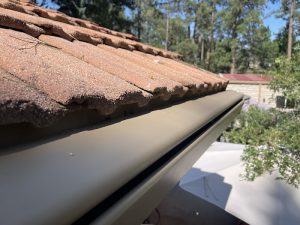
K-Guard’s answer on the hardware side is size and support. Troughs and downspouts are about 40 percent larger than typical guards. They ride on patented all-weather polymer hangers set every 24 inches, and the seamless gutter is heavy-duty non-corrosive aluminum formed on site.
Where the water goes matters as much as the gutter
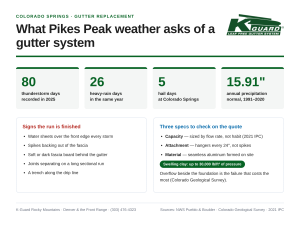
This is the Colorado-specific piece. The Colorado Geological Survey identifies swelling soil as the state’s most damaging geologic hazard. Its clays can expand up to 20 percent by volume and they can exert up to 30,000 pounds per square foot when they get wet (Colorado Geological Survey).
CSU Extension’s PlantTalk Colorado guidance for homes on these soils is very specific. Roofs need to be graded so water drains away from the house. Keep irrigation and plantings back from the foundation, and resist the temptation to pull downspout extensions off to water beds near the house (PlantTalk Colorado 1617). The Colorado Geological Survey’s homeowner guide covers the same drainage discipline in more depth (CGS SP-14).
A gutter that discharges two feet from the wall is doing only half a job. Extensions, splash blocks, or buried drain lines are part of the install. They carry water past the backfill zone, and they are not an afterthought.
Permits and HOA approval in the Denver metro
Two separate approvals can be required.
City side. Denver regulates roof drainage and storm water discharge. The residential code’s storm drainage chapter governs materials, design and installation of storm drainage on a home (Denver Residential Code, Chapter 33). DOTI handles sewer use and drainage permits where a project changes site drainage (Denver DOTI). A like-for-like gutter replacement is a different animal from re-routing site drainage. Ask your contractor which one your project is.
HOA side. In a metro full of covenant communities, this is the approval that most often actually delays jobs. Colorado’s Common Interest Ownership Act says a decision on an owner’s architectural application must follow standards in the declaration or duly adopted rules. It cannot be arbitrary or capricious (C.R.S. 38-33.3-302(3)(b)) (Colorado legislative summary of CCIOA limits). Submit color and profile with the application, and keep the written response.
What separates a good install from a cheap one
| Detail | Cheap job | Job that lasts |
|---|---|---|
| Attachment | Spikes into fascia | Bracket or hanger system at defined spacing |
| Trough | Sectional lengths joined on site | Seamless, formed on site |
| Slope | Hung to look level | Hung to a measured slope for capacity |
| Downspouts | Reuse old drop locations | Placed and counted for the roof area |
| Discharge | Splash block at the wall | Extended past the backfill zone |
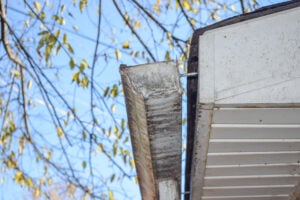
| Fascia | Hung over soft wood | Rot repaired before hardware goes up |
| Coverage | Verbal | In writing, and transferable with the home |

FAQ
Q: How long does gutter installation in Denver take? A: Most single-family homes are a one-day install. Complex rooflines, steep pitches, and fascia repair discovered after the old system comes off can extend it to two days.
Q: What size gutters do Denver homes need? A: There is no single answer, because size follows roof area and slope. The adopted 2021 plumbing code turns a 2.4 inch-per-hour design rainfall and the roof area into a flow rate. The seamless gutter is then sized against a capacity table (2021 IPC Chapter 11). Ask your estimator to show the reasoning.
Q: Do I need a permit for new gutters in Denver? A: A straightforward gutter replacement is usually not the trigger. Changing where storm water discharges can be, because Denver regulates storm drainage under its residential code and drainage permits (Denver Residential Code Ch. 33; Denver DOTI). Confirm scope before the crew arrives.
Q: How far should downspouts discharge from the house? A: Far enough to get water past the backfill zone. On Colorado’s swelling clays, CSU’s PlantTalk guidance warns specifically against removing downspout extensions to water beds near the foundation (PlantTalk Colorado).
Q: Will my HOA need to approve the color? A: In most covenant communities, yes. Under Colorado’s Common Interest Ownership Act the association’s decision has to follow its own written standards and cannot be arbitrary or capricious (Colorado legislative summary). Submitting the exact color and profile up front avoids a second review cycle.
Q: Is it worth installing gutter protection at the same time as new gutters? A: Combining them means one system, one set of hangers, and one point of accountability, rather than a cover retrofitted onto a trough that was not designed for it.
Get a system sized for your home
K-Guard Rocky Mountains is a family-owned company. We install the K-Guard Leaf Free Gutter System, a curved-hood seamless gutter in 37 colors, across Denver and the Front Range. Done properly, gutter installation and repair work is protection for the foundation and siding, and curb appeal that holds its color. See how hooded systems compare on the best gutter guard page, review financing options, or request pricing for your home.