
Gutter hangers are the brackets that hold your gutter to the fascia board. On a Front Range home they work hardest from fall through spring. Denver averages snow in every month from October through May, and March is the snowiest at 11.4 inches (NWS Boulder).

The four kinds of gutter hangers you’ll find on Colorado homes
The HUD Rehab Guide groups hangers into four types: hanger and strap, hanger and bracket, spike and ferrule, and concealed hangers (HUD Rehab Guide, Vol. 3: Roofs).
- Spike and ferrule. A long nail runs through the gutter and a sleeve called a ferrule into the fascia. HUD says this type is more likely to pull out because the gutter expands and contracts around the spike.
- Hidden hangers. These clip under the front lip inside the gutter and screw into the fascia. HUD lists them as strong, easy to install and able to let the gutter move with temperature swings.
- Brackets. A bracket mounts to the fascia and cradles the gutter from below.
- Roof straps. A strap runs up under the shingles and nails to the roof sheathing, which suits eaves with no fascia board.
Whatever the type, gutters are less likely to pull free when the screws reach the framing behind the fascia board, according to Fine Homebuilding. The same guide says that hidden hangers work best with stiffer 0.032-inch gutter stock.
Snow and ice add weight that your gutter hangers have to carry
Gutters aren’t designed to hold your roof’s snow load, but they do hold the slush and ice that sits in the channel at the roof edge. FEMA’s snow load guide puts a foot of fresh snow at 3 pounds per square foot for light powder and up to 21 pounds for wet, heavy snow (FEMA P-957). It also says an inch of ice weighs a little less than 5 pounds per square foot, so ice is heavier than wet snow inch for inch. A thaw followed by a hard freeze can turn the water in your gutter into a solid bar that the hangers have to hold until it melts.
How gutter hanger spacing changes the load on each bracket
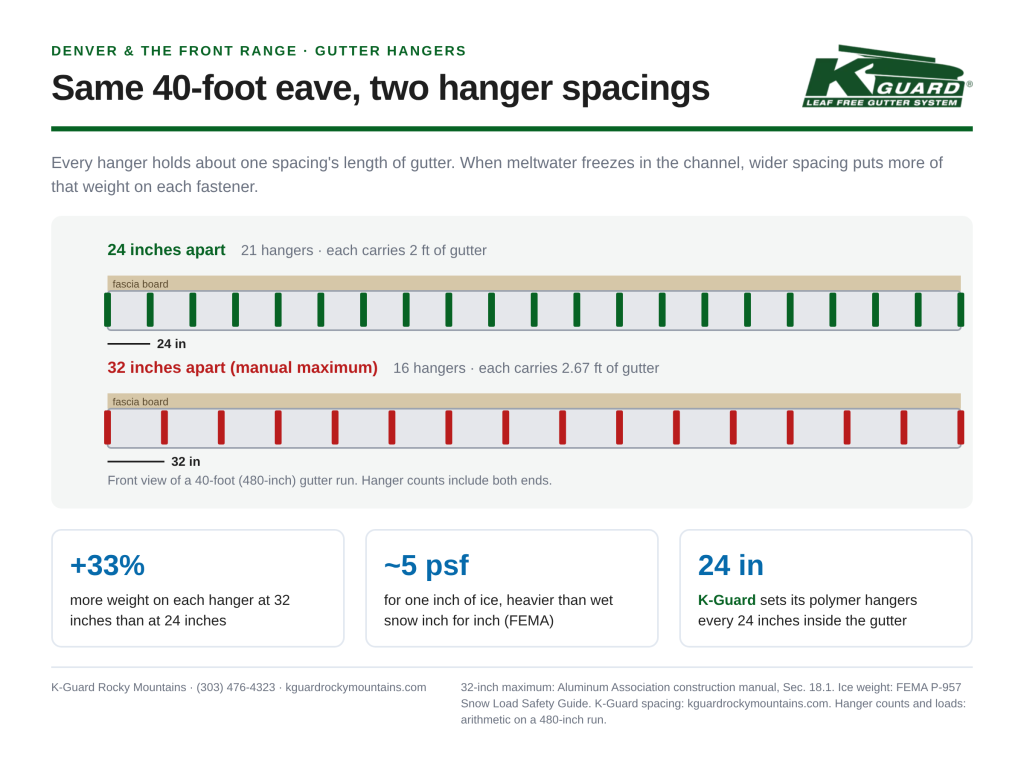
The Aluminum Association’s construction manual says hangers or straps should be spaced no more than 32 inches apart (Aluminum Association manual, Sec. 18.1). Fine Homebuilding gives the same figure and recommends closer spacing where snow or ice loads are heavy. Each bracket carries about one spacing’s length of gutter, so wider gaps put more weight on every fastener.
| Spacing (on center) | Brackets on a 40-ft eave, ends included | Gutter each bracket carries | Weight per bracket compared with 24 in |
|---|---|---|---|
| 16 in | 31 | 1.33 ft | one-third less |
| 24 in | 21 | 2 ft | baseline |
| 30 in | 17 | 2.5 ft | one-quarter more |
| 32 in (manual maximum) | 16 | 2.67 ft | one-third more |
The table assumes the weight is spread evenly along the gutter, whether it’s rainwater, slush or ice.
Signs your gutter hangers are losing their grip
HUD notes that most gutter repair means refastening loose hangers, replacing broken ones and adding hangers where the spacing was too wide. You can spot the warning signs from the ground after a thaw:
- A gap between the back of the gutter and the house, or a gutter that tips forward
- Low spots where water or ice sits instead of draining
- Spike heads backing out of the front of the gutter
- Water stains or peeling paint on the wood right behind the gutter
Soft or dark trim is worth a closer look, because a hanger can’t hold in rotted wood. The K-Guard Rocky Mountains guide to fascia rot and sagging gutters explains how the two problems feed each other.
Questions to ask about hangers in any gutter bid
Before you sign, ask each installer how the gutter will be held up:
- What type of hanger will you use, and how many inches apart?
- Will the screws reach the framing behind the trim board?
- What thickness of aluminum is the gutter?
- Will you repair soft wood before the new gutter goes up?
- Will the back edge sit higher than the front? The Aluminum Association manual calls for the inner edge to finish at least 1 inch above the outer edge, so overflow spills out the front and away from your house.
How the K-Guard system handles hanger spacing
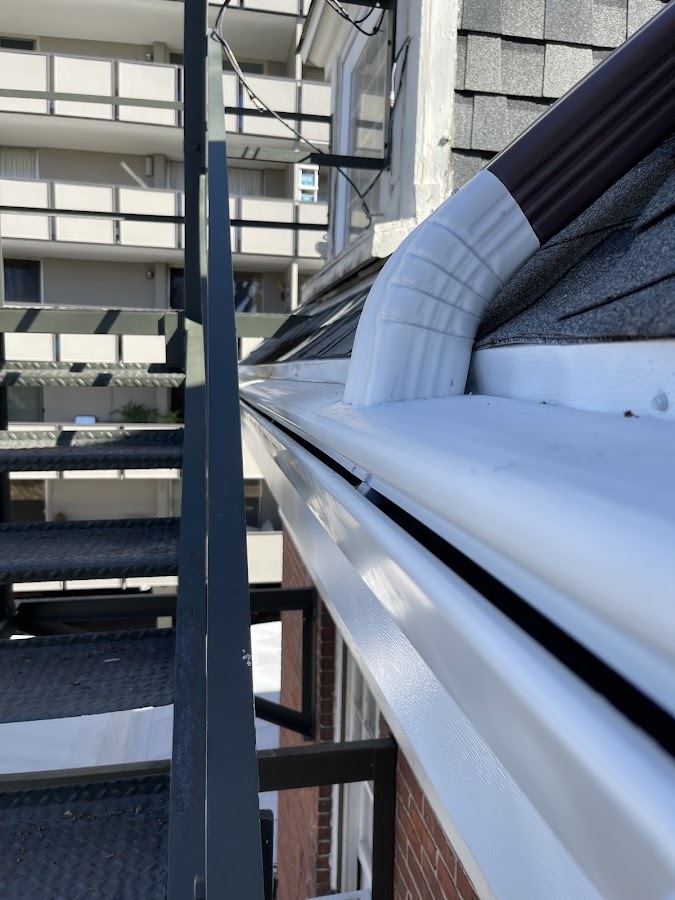
The K-Guard Leaf Free Gutter System uses patented, all-weather polymer hangers set every 24 inches inside the gutter, and they fully support the hood and keep the gutter from sagging (K-Guard Rocky Mountains). K-Guard says the hangers support the gutter from front to back with an angled design for added leverage, and that the hood and gutter protect them from the weather (K-Guard FAQs). They come with a new seamless, non-corrosive aluminum gutter with the curved hood built in, shown on the K-Guard product page.
Frequently asked questions
How far apart should gutter hangers be? The Aluminum Association manual sets 32 inches as the maximum, with closer spacing recommended under heavy snow and ice. The K-Guard system sets its hangers every 24 inches.
Are hidden hangers better than spikes? HUD says spike and ferrule hangers are more likely to pull out because the gutter moves around the spike. Hidden hangers let the gutter expand and contract, and they work best with heavier gutter stock.
Can I add hangers to a sagging gutter? Yes, HUD lists added hangers as a standard repair where spacing was too wide. If the wood behind the gutter is rotted, it needs repair first or the new screws won’t hold.
What areas does K-Guard Rocky Mountains serve? K-Guard Rocky Mountains serves the Front Range from Fort Collins south to Colorado Springs, roughly 30 miles east and west of I-25, including Denver, Aurora, Boulder, Castle Rock, Lakewood and Longmont. If your town isn’t listed, call (303) 476-4323 to check your address.
How will K-Guard Rocky Mountains keep me updated during the project? The team explains what they find during your free estimate, walks you through your options and answers questions as they come up.
Gutter hangers that are spaced close and fastened into solid framing help protect your trim, siding and foundation through a Front Range winter. To see a system with hangers every 24 inches on your home, request a free written estimate on the K-Guard Rocky Mountains pricing page or call (303) 476-4323.


