
You’ve watched your gutters sway during a windstorm. Maybe you’ve heard them rattle against the house at 2 AM when a front moves through. Or worse — you’ve walked outside after a strong winds to find a section hanging loose, held on by one or two screws while water pours behind it onto your foundation.
That feeling — knowing something is wrong but not knowing if it’ll hold through the next storm — is exhausting. And in Colorado, where 40-50 mph gusts are standard spring weather and 70+ mph winds hit the Front Range several times a year, loose gutters aren’t a cosmetic problem. They’re a countdown to damage.
Why Gutters Pull Away From Your Home
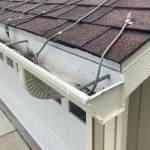
Many home’s gutters are held to the fascia board with spikes and ferrules — essentially long nails driven through the gutter into the wood. Some newer installations use hidden hangers spaced 36 inches apart. Both methods have the same weakness: they rely on a few points of contact to hold up an entire gutter system filled with water, ice, and debris.
When wind hits your home, it doesn’t just push on the gutters — it creates lift. The same principle that gets an airplane off the ground tries to peel your gutters off the house. Add Colorado’s freeze-thaw cycles, which loosen fasteners over time, and you have a system that’s physically separating from your home inch by inch.
The fascia board itself often becomes part of the problem. Older homes — especially those built in the 1970s and 1980s — frequently have fascia boards that have rotted or softened from years of water exposure. When screws are driven into compromised wood, they don’t hold. You might tighten them today, and they’ll be loose again in six months.
What Happens When Gutters Fail in Strong Winds
A gutter that pulls away even slightly creates a gap between the back of the gutter and the fascia. Water flows into that gap instead of down the downspout. It soaks into the fascia, the soffit, and eventually the roof decking. You won’t see it happening — it’s behind the gutter — but within two or three seasons, you’ll have wood rot that requires extensive carpentry work.
The average cost to repair fascia damage on a typical Colorado home runs $1,400 to $3,000. If the rot has spread to the soffit or roof decking, that number doubles. And because this damage happens slowly, most homeowners don’t catch it until it’s serious.
Then there’s the foundation issue. When a gutter section pulls away during a storm, water pours directly down the side of your house instead of being directed away from the foundation. One heavy rainstorm — the kind we get in May and June when the afternoon thunderstorms roll in — can dump hundreds of gallons of water right next to your basement wall. That water finds its way in, either through cracks or through hydrostatic pressure that forces it through the concrete itself.
Foundation water intrusion repairs in the Denver area start at $4,000 and routinely exceed $15,000 when structural work is required. That’s not a repair you budget for. That’s an emergency.
Why Standard Repairs Don’t Hold

If you call a handyman or a general gutter company, they’ll reattach the loose section with new screws, maybe add an extra hanger or two, and charge you $150-$400. The work will look fine. It might even hold through the summer.
But the underlying problem hasn’t changed. The fascia is still the same condition it was before. The gutter is still the same weight when it fills with water and ice. The wind is still going to hit your home with the same force next spring. You’re not solving the problem — you’re resetting the clock.
Some homeowners try gutter straps, which wrap over the top of the gutter and attach to the roof. These can work temporarily, but they create new problems. They put stress on the roof edge, they can void your roof warranty, and they still don’t address the core issue: your gutter system was never designed to handle Colorado weather.
What a Permanent Solution Looks Like
A gutter system that handles strong winds needs three things: continuous support along its entire length, secure attachment to structure that won’t degrade, and a design that minimizes wind lift in the first place.
Standard gutters fail on all three counts. They’re supported at intervals, not continuously. They attach to wood that’s often compromised. And their open-top design catches wind like a sail.
A properly engineered system uses hangers spaced no more than 16 inches apart — some use continuous mounting along the entire run. It attaches to the fascia in a way that distributes load and prevents point-stress failures. And it’s designed to shed wind rather than catch it.
You also need to consider the fascia itself. If it’s rotted or soft, no amount of better fasteners will help. Any legitimate solution includes inspecting and, if necessary, replacing compromised fascia before new gutters go up. Skipping that step means you’re building on a bad foundation.
What to Ask a Gutter Company
When you’re evaluating options, ask specific questions about how the system attaches to your home. Ask how many hangers they use per linear foot. Ask if they inspect and repair fascia as part of the installation. Ask what happens if a section pulls away during a windstorm — is that covered under warranty, or is it considered “act of God” damage that you pay for?
A company that knows what they’re doing won’t dodge these questions. They’ll walk you through exactly how their system is mounted, why it’s engineered that way, and what protections you have if something goes wrong.
Be especially wary of companies that want to add straps or brackets to your existing gutters. That’s a band-aid. It might buy you a year, but it doesn’t fix the underlying problem, and you’ll be calling someone again when the next windstorm hits.
Next Steps for Securing Your Gutters Against Colorado Winds
- Inspect your current gutters after the next windstorm — look for gaps between the gutter and fascia, sagging sections, or visible movement when you push on them.
- Check your fascia board for soft spots, rot, or water staining — if it’s compromised, it needs to be replaced before any gutter work is done.
- Get quotes from companies that offer engineered mounting systems, not just standard replacements with extra hangers.
- Ask about warranties that specifically cover wind damage and gutter separation — if it’s not in writing, it’s not covered.
- Consider the long-term cost of repeated repairs versus a permanent solution — This article helps you to determine if repairs or replacement are best for your gutters.
The K-Guard Rocky Mountain Perspective
K-Guard’s mounting system is built for Colorado wind. Our gutters are fastened with heavy-duty hangers every 24 inches maximum — closer spacing than industry standard — and each hanger is secured with screws engineered for wind load, not just weight. The integrated hood design reduces wind lift by eliminating the open channel that acts like a sail on standard gutters. We inspect fascia before every installation and replace damaged sections as part of the job, not as an upsell. Our lifetime warranty covers separation and wind damage — if a section pulls away, we fix it at no cost. That’s not something most companies will put in writing.
K-Guard Rocky Mountain installs a permanent, maintenance-free gutter system built for Colorado homes. If your current gutters are pulling away and you’re tired of temporary fixes, schedule a free quote with our team. We’ll inspect your fascia, assess the attachment points, and show you exactly what a wind-rated system looks like on your home.