Poor Drainage Leads to Foundation Issues
You’ve likely walked past your home’s foundation a hundred times without giving it much thought. But if water pools near your basement walls after a rainstorm, or if you’ve noticed a musty smell coming from your lower level, your foundation is trying to tell you something.
Foundation repairs in Colorado average between $4,000 and $15,000, and severe cases can run much higher. The frustrating part? Most foundation water damage is entirely preventable. It comes down to one thing: where the water goes when it leaves your roof.
What is Foundation Damage?
Your foundation wasn’t designed to sit in water. When soil around your basement walls stays saturated, hydrostatic pressure builds up. Essentially, water pushing against concrete that was never meant to hold back a pond. Over time, this pressure finds the smallest crack or seam and works its way inside.
Colorado’s freeze-thaw cycles make this worse. Water that seeps into small foundation cracks expands when it freezes, widening those cracks with every winter. What starts as a hairline fracture in November can become a structural concern by March.
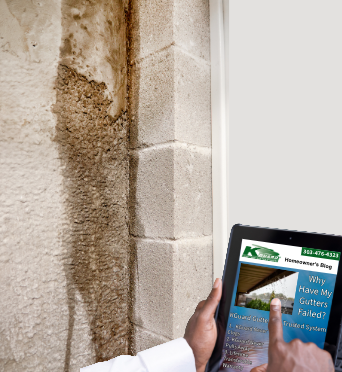
The earliest signs are easy to miss. You might see white, chalky residue on your basement walls — that’s efflorescence, a mineral deposit left behind when water evaporates through concrete. Or you notice damp spots that appear after heavy rain, even though you can’t see an obvious leak. By the time water is visibly pooling in your basement, the problem has been developing for months or years.
How Water Should Move Away From Your Home
Proper foundation drainage starts with the ground itself. The soil around your home should slope away from your foundation at a minimum grade of 6 inches over 10 feet. That means if you measure 10 feet out from your foundation wall, the ground should be at least 6 inches lower than where it meets your house.
Why that specific measurement? It’s enough of a slope to move water away from your foundation without creating erosion problems in your yard. Water follows gravity — if the path of least resistance leads away from your house, that’s where it goes.
But grading alone isn’t enough. Your roof collects thousands of gallons of water during Colorado’s spring storms and snowmelt season. A typical 2,000 square foot roof sheds about 1,250 gallons of water for every inch of rainfall. Without a functioning gutter system, all of that water dumps directly onto the soil next to your foundation.
This is where gutters and downspouts become critical. They’re not cosmetic. They’re part of your home’s structural protection system. Gutters collect roof runoff and channel it through downspouts that should extend at least 4 to 6 feet away from your foundation. The water then follows your yard’s natural grading away from the house.
When any part of this system fails — clogged gutters, disconnected downspouts, poor grading — water takes the easiest path, which is usually straight down alongside your foundation.
Assess Your Home For Poor Drainage and Foundation Risks
You don’t need professional equipment to assess your home’s drainage. Start with a visual inspection during the next rainstorm. Watch where water flows when it comes off your roof. Does it shoot past clogged gutters and pour directly onto the ground? Do your downspouts empty right next to your foundation, or do they carry water several feet away?
Walk around your home’s perimeter the day after a heavy rain. Look for these warning signs that your gutters may be failing:
- Soil that stays soggy or muddy near your foundation while the rest of your yard has dried out
- Water stains on your foundation walls, especially near ground level
- Settling or sinking soil directly against your foundation — this creates a bowl that traps water
- Mulch or landscaping materials that slope toward your house instead of away from it
- Gutters that overflow during moderate rain, indicating they’re clogged or undersized
Inside your home, check your basement or crawl space for condensation on walls, a persistent musty odor, or that white powdery efflorescence on concrete. These are all signs that moisture is working its way through your foundation, even if you haven’t seen standing water yet.
Colorado homeowners in areas with clay soil face an additional challenge. Clay expands when wet and contracts when dry, creating pressure against foundation walls that shifts with the seasons. If your soil is heavy clay, proper drainage becomes even more important to minimize these expansion and contraction cycles.
When Grading Isn’t Enough
You can have perfect yard grading and still end up with foundation water problems if your gutters aren’t doing their job. In fact, the most common scenario we see is homeowners who’ve spent money re-grading their yards without addressing failing gutters… and the water damage continues.
Standard gutters in Colorado face two high-risk seasons. Late May through June brings cottonwood seed season, when fluffy white seeds combine with spring pollen to create a dense mat that blocks water flow. Then fall arrives with pine needle drop in the foothills and leaf accumulation in urban areas. Both seasons can turn open gutters into overflowing planters within weeks.
When gutters clog, they stop directing water away from your home. Instead, water overflows the sides and pours directly onto the ground next to your foundation — exactly what the gutter system was installed to prevent. You end up with the worst of both worlds: you paid for gutters, but they’re creating the same foundation risk as having no gutters at all.
This is also why gutter guards that still require cleaning don’t fully solve the problem. If you’re 75 years old and living independently, climbing a ladder twice a year to clean gutter inserts isn’t a realistic maintenance plan. The system needs to work without requiring you to maintain it.
Reduce the Risk to Your Foundation
- Check your yard grading. Use a 10-foot board and level to measure the slope away from your foundation. If it’s less than 6 inches over 10 feet, re-grading may be needed in problem areas.
- Inspect your gutters during the next rainstorm. Are they channeling water, or is water pouring over the sides? If they overflow during moderate rain, they’re either clogged or undersized for Colorado weather.
- Verify your downspout extensions. They should carry water at least 4 to 6 feet from your foundation. If they empty right next to the house, add extensions or splash blocks.
- Look for drainage evidence the day after heavy rain. Soggy soil, standing water, or visible erosion near your foundation all indicate water isn’t moving away as it should.
- Address basement warning signs immediately. Musty odors, efflorescence, or damp spots mean water is already reaching your foundation. The longer you wait, the more expensive the fix becomes.
The K-Guard Rocky Mountains Perspective
We install gutter systems for Colorado homeowners who understand that foundation protection isn’t optional. K-Guard’s patented hood design keeps debris out — no cottonwood seeds, no pine needles, no fall leaves. The larger 6-inch gutters handle the high water volume from spring snowmelt and summer thunderstorms, and our downspouts are sized to match. You get a system that works year-round without requiring you to climb a ladder or hire someone to clean it. That’s paired with a lifetime transferable warranty, because a drainage system should last as long as your home does.
K-Guard Rocky Mountain installs a permanent, maintenance-free gutter system built for Colorado homes. If you’re ready to stop worrying about foundation water damage, contact our team.