
Gutter Replacement in Colorado Springs: How to Tell It’s Time, and What to Put Up Instead
When we come out to look at a gutter system in Colorado Springs, we usually see a stain running down the siding after a July storm, or a spike that has worked its way out of the fascia. Pikes Peak weather makes the next decision harder than it looks. Short, violent storms, a long hail season, and swelling clay soil under many neighborhoods all put pressure on a system you probably never think about.
Below are the signs that repair is no longer enough, what our climate demands of a replacement, how we run the job, and what you should ask before you sign anything.
What Colorado Springs weather does to a gutter system
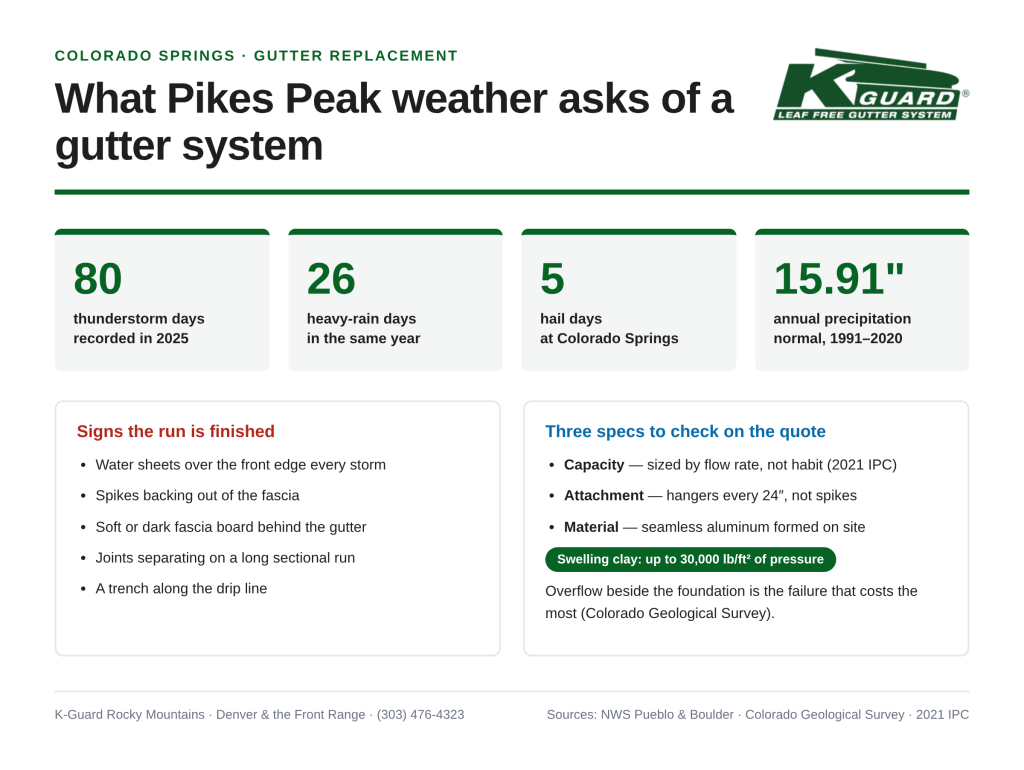
In 2025 the National Weather Service logged 80 thunderstorm days at Colorado Springs. It also logged 26 heavy-rain days and 5 hail days (NWS Pueblo Annual Summary 2025). Hail is the defining hazard here. NWS Pueblo’s severe weather climatology shows hail as the leading severe storm report across southeast and south-central Colorado (NWS Pueblo).
Total moisture is modest. The 1991–2020 normal is 15.91 inches of precipitation and 32.5 inches of snow, and it arrives in bursts.
| Colorado Springs climate measure | 1991–2020 normal | 2025 observed |
|---|---|---|
| Precipitation | 15.91 in | 16.28 in |
| Snowfall | 32.5 in | 27.5 in |
| Thunderstorm days | — | 80 |
| Heavy rain days | — | 26 |
| Hail days | — | 5 |
| Largest 24-hour rainfall | — | 1.10 in (Aug 25–26) |
Source: NWS Pueblo Annual Summary 2025 for Colorado Springs.
A gutter here spends most of the year nearly dry, then has to move a summer cloudburst off the roof in twenty minutes. Undersized or sagging gutters do not fail gradually in that pattern. They overflow, and the water lands next to the foundation.
That matters more in Colorado than in most states. The Colorado Geological Survey calls swelling soil the state’s most significant geologic hazard. Bentonite and montmorillonite clays can expand up to 20 percent by volume when they get wet. They can exert forces up to 30,000 pounds per square foot (Colorado Geological Survey). CSU’s PlantTalk Colorado guidance is blunt about the fix. Grade so water drains away from the house. Leave downspout extensions in place instead of pulling them off to water flower beds (PlantTalk Colorado 1617).
Repair or replace: what we look for
We can seal a single leaking seam or re-secure a loose hanger in an afternoon.
| What you see | Likely cause | Repair or replace |
|---|---|---|
| Water sheeting over the front edge in every storm | Undersized trough, or slope lost | Replace the run |
| Spikes backing out; gutter pulling from the fascia | Hanger spacing and fastener failure | Replace with a hanger system |
| Soft, dark, or crumbling fascia board behind the gutter | Long-term overflow | Replace, after the fascia is repaired |
| Dents and dimples across the top edge after a storm | Hail on thin-gauge aluminum | Judgment call; check for splits |
| Joints separating on a long sectional run | Thermal movement at seams | Replace with seamless |
| Peeling paint, mud spatter, or a trench along the drip line | Chronic overflow | Replace and extend downspouts |
Once the wood behind the gutter is soft, no re-hang holds for long, because any new system needs solid wood to fasten to. If your fascia boards have gone dark, budget for carpentry alongside the new gutters.
What we specify on a replacement
Capacity. Colorado’s adopted 2021 plumbing code sizes drainage from a 100-year, one-hour rainfall rate. The code’s city table lists 2.4 inches per hour for Denver. Horizontal gutters are sized by flow rate, not by habit (2021 IPC Chapter 11, Colorado; Appendix B rainfall rates). A steep roof with a big drainage area and one downspout will overflow no matter how well it is hung.
Attachment. Spikes driven into fascia are the oldest failure point in the trade, so we spread the load with a hanger system. Our K-Guard Leaf Free Gutter System rides on patented all-weather polymer hangers spaced every 24 inches, with troughs and downspouts about 40 percent larger than typical guards.
Material and finish. We form the seamless trough on site, which removes the joints that separate first. The metal is heavy-duty non-corrosive aluminum, and we carry 37 colors, so matching the trim on a stucco or brick home is easy.

How we run the job
- Measurement and design. Roof area, pitch, valley locations and downspout drops decide the size and the number of drops, not the old layout by default.
- Fascia inspection. Any soft board is repaired or replaced before hardware goes up.
- Removal and disposal of the old system.
- On-site forming. Seamless trough is rolled to the length of each run.
- Hanging and hooding. Hangers are set, the trough is hung to slope, and the hood section is installed.
- Downspouts and discharge. Drops are placed where water can be carried away from the foundation, then extended past the backfill zone.
- Walkthrough. Water test, cleanup, and a review of what was installed.
Most single-family replacements take us one day. Complex rooflines, steep pitches, or fascia carpentry can push it to two.
Permits, HOAs, and timing in the Springs
Pikes Peak Regional Building Department lists roofing among the projects that need a homeowner permit, and gutters are not on that list (PPRBD homeowner permits). Scope can still change the answer, so we check with PPRBD before we start. If you’re in an association, a color or profile change may need architectural review first. Colorado’s Common Interest Ownership Act requires your association to follow the standards written into its own declaration or adopted rules when it makes that call, and it cannot be arbitrary or capricious (C.R.S. 38-33.3-302; Colorado legislative summary).
Our busy stretch runs through summer storm season and leaf drop, so booking before the first hard freeze gives us dry fascia to work with.
Questions to ask any gutter installation and repair company
- What trough and downspout size are you specifying, and how did you arrive at it?
- How is the system attached, and at what spacing?
- Is the trough seamless and formed on site?
- What happens if the fascia is rotted once the old gutter comes off?
- Where will the downspouts discharge, and how far from the foundation?
- What is covered in writing, and does coverage transfer if we sell?
FAQ
Q: How long should a gutter system last in Colorado Springs? A: Service life depends on attachment, capacity and hail exposure far more than on age. A system that still slopes correctly, sits on solid fascia, and holds a heavy summer storm is doing its job. One that fails any of those tests is near the end, whatever its age.
Q: Does hail damage mean I need new gutters? A: Not automatically. Cosmetic dimples in aluminum are common after a hail day, and Colorado Springs recorded five in 2025 (NWS Pueblo). Splits, crushed sections and gutters knocked out of slope are more serious. Have someone check the fascia and the slope, not just the face of the trough. Isolated damage is usually a repair, and a run that has lost its slope usually needs replacing.
Q: Do I need a permit to replace gutters in Colorado Springs? A: Roofing appears on the Pikes Peak Regional Building Department’s list of homeowner projects requiring a permit, and gutters do not, but the department is the authority on your specific scope (PPRBD). Call them if the work touches the roof edge or structure.
Q: Can my HOA reject the gutter color I want? A: An association can enforce architectural standards. Under the Colorado Common Interest Ownership Act, though, its decision has to follow the standards written into its declaration or adopted rules, and cannot be arbitrary or capricious (Colorado legislative summary). With 37 K-Guard colors available, most homeowners find an approved match.
Q: Why does gutter overflow matter so much on Front Range soil? A: Because the clays under many Colorado neighborhoods swell when they get wet. The Colorado Geological Survey reports expansion up to 20 percent by volume and pressures up to 30,000 pounds per square foot (CGS). Water dumped beside the house is exactly the condition to avoid.
Q: Is seamless really different from sectional gutter? A: Sectional runs have joints, and joints are where leaks start after years of thermal movement. We form a seamless gutter on site to the length of the run, so the only joints sit at corners and outlets.
We are a family-owned company, and we install the K-Guard Leaf Free Gutter System across the Front Range, including Colorado Springs. Done right, it protects your foundation, siding and landscaping, in a color that matches the house. If you want to see how hooded systems stack up against screens and micro-mesh before you decide, our gutter guard comparison page walks through the differences, or you can request pricing for your home and get in touch.