The Maintenance Question You Need to Ask Before Buy
You’ve spent three decades maintaining your home. And now you are considering options that that will take care of themselves instead of you cleaning regularly. Every ad says “low maintenance”. But what does that actually mean? It means less maintenance than before, but it’s still maintenance. So when a gutter guard salesperson tells you their system is “virtually maintenance-free,” you’re right to be skeptical. Because in your experience, nothing attached to a house is truly free of upkeep.
Not all gutter guards are equal. Reading through blogs and research online, you find time and again statements saying all gutter guards require some level of maintenance (articles such as this one). They make you believe that the real question is how much maintenance, how often, and whether you’re trading one headache for another.
K-Guard gutters are different. They are 100% maintenance-free!
What “Maintenance-Free” Actually Means in the Gutter Guard Industry
The gutter guard market uses the term “maintenance-free” liberally. What they usually mean is that you won’t need to clean inside your gutters as often. But that’s different from not needing to touch the system at all.
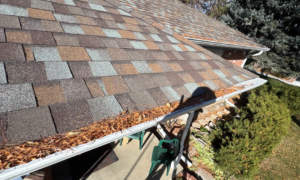
Most mesh and screen-style gutter guards accumulate debris on top of the guard itself. In Colorado, that means pine needles from your neighbor’s blue spruce, cottonwood seeds in late spring, and aspen leaves in October. These don’t fall through, clogging your gutters. They sit on top and dry into a mat. During our heavy May snowmelt or a summer thunderstorm, water can’t penetrate the debris layer fast enough. It overshoots the gutter entirely and dumps straight onto your foundation.
So yes, you’re not cleaning gutters anymore. But now you’re brushing off gutter guards — usually twice a year if you’re diligent, more often if you have mature trees nearby. You’re still on a ladder. You’re still dealing with decomposing organic matter. And if you hire someone to do it, you’re still paying $150-$300 per visit.
K-Guard’s Leaf Free System, on the other hand, truly promises that you are hands off once they are installed on your home. If you even think there may be a clog, you call us and we come make sure the system is working properly.
The Three Types of Gutter Guard Maintenance
There are many different gutter guard options and each design requires different types of upkeep. Understanding this before you buy matters more than the initial price tag.
Mesh and Micro-Mesh Systems
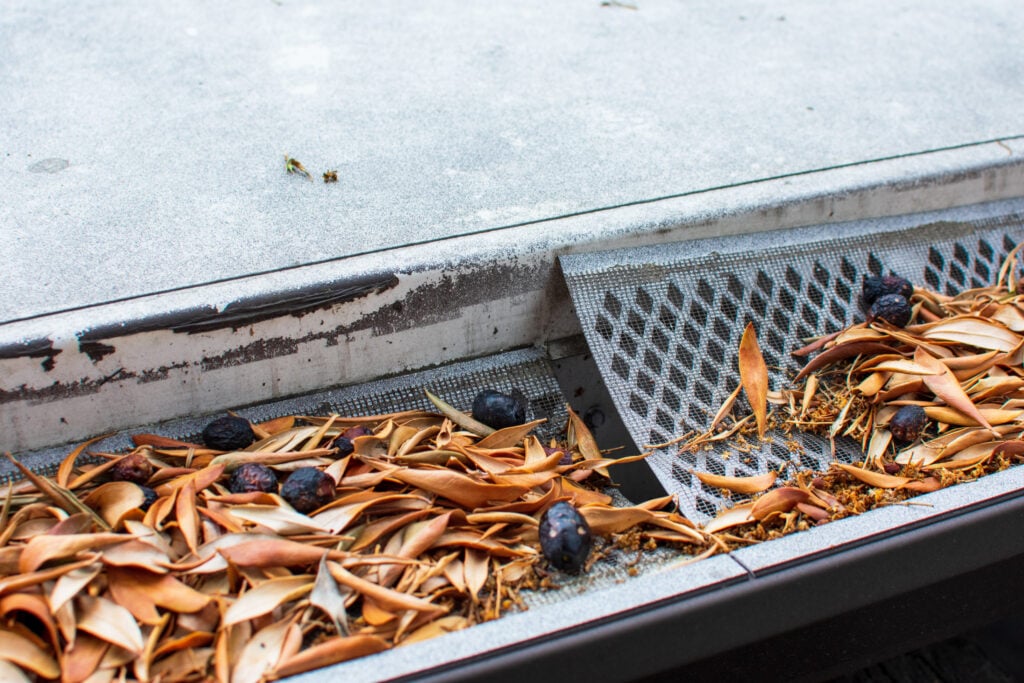
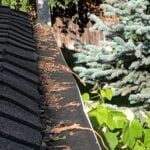
These use fine screens installed across the gutter opening. They block most debris from entering the gutter itself, but everything lands on top of the mesh. In the Denver metro area, that means using a metal brush to remove cottonwood fluff in June (which becomes a paste when wet), pine needles that weave into the mesh throughout fall and winter, and roof grit that clogs the tiny holes over time.
Typical maintenance schedule: brush or blow off debris 2-4 times per year. Every 3-5 years, remove the guards entirely to clean sediment buildup underneath. This may be required more often depending on the types of debris you have and how close trees are to the house. Cost to hire out: $200-$400 annually if you’re not doing it yourself. Click this link to read more about the difference between K-Guard and high grade screens.
Foam and Brush Inserts
These sit inside the gutter and theoretically filter water while blocking debris. In practice, they become biological experiments. Organic matter decomposes inside the foam or brush bristles. Seeds germinate. We’ve seen homeowners pull out inserts that are sprouting actual seedlings.
Typical maintenance schedule: remove, rinse, and reinstall every 6-12 months. Replace entirely every 2-4 years as the material degrades. These are the highest-maintenance option and rarely last beyond a few Colorado freeze-thaw cycles. You can explore more about these types of guards at this link.
Solid Hood Systems

This category includes reverse-curve designs and systems like K-Guard that use a patented curved hood. Water follows the curve into the gutter via surface tension; debris slides off the front edge. Because nothing accumulates on top, there’s nothing to brush off.
Typical maintenance schedule: none, if the system is properly designed and installed. The difference comes down to engineering, specifically, whether the design can handle Colorado’s heavy snowmelt flow rates and whether the system is actually sealed or just covered. You can explore more about curved hood options here.
Seasonal Gutter Guard Maintenance in Colorado
Colorado’s climate creates four distinct challenges that most gutter guards can’t handle without help from you.
Spring (March-May): Snowmelt is the most demanding period for any gutter system. A poorly maintained gutter guard can cause ice damming as meltwater refreezes at night. Mesh systems often need clearing in early April before the cottonwood bloom begins in late May. Build up of debris and ice on the guard will slow the water going into the gutters, causing water to fall onto your foundation instead of running through the system and out the downspout as needed.
Summer (June-August): Afternoon thunderstorms dump water faster than most standard gutters can process. If debris has built up on mesh guards during spring, you’ll see overflow during storms. Foam inserts start breaking down in our high UV exposure.
Fall (September-November): Aspen and cottonwood leaves, plus pine needles create the heaviest debris load. Mesh systems need cleaning in mid-October and again in late November. This is when most homeowners realize their “maintenance-free” system still requires a ladder.
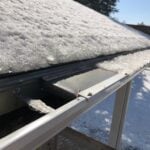
Winter (December-February): Ice dams form when water can’t drain properly. Clogged or debris-covered guards prevent drainage, causing water to back up under shingles. Foundation damage occurs when overflow freezes and thaws repeatedly at ground level.
Is Any Gutter Guard System Truly 100% Maintenance-Free?
This is the question you should ask every contractor before signing anything. Most will hedge. They’ll say “virtually” maintenance-free or “minimal” maintenance. That’s your answer — it requires maintenance.
Or they may say that you never need to clean the gutters. But if you have to clean the guard, there’s still maintenance involved.
A genuinely maintenance-free system needs to meet three criteria:
First, nothing can accumulate on the guard surface. If debris piles up on top, you’ll eventually need to remove it. This eliminates most mesh, screen, and perforated systems.
Second, the system must be fully enclosed. If there are gaps, slots, or openings allowing debris to enter, it will. Small debris that makes it inside will eventually accumulate and require cleaning. Unless the system is made specifically for flushing any debris out.
Third, the system must handle Colorado’s actual water volume. Standard 4-inch gutters can’t process our heavy snowmelt or thunderstorm volume. When water overshoots the gutter because the system is undersized, you get foundation problems regardless of how clean the guard is.
Systems that meet all three criteria are rare. Most gutter guards meet one or two of these standards, but compromise on the third.
What to Do About Gutter Guard Maintenance
If you already have gutter guards installed and they’re accumulating debris, you have three options. None of them are free, but one is permanent.
Option One: Accept the maintenance schedule and factor the cost into your annual home budget. Budget $350-$500 per year if you’re hiring it out, or plan on spending 4-6 hours per year on a ladder if you’re doing it yourself. This works if you’re comfortable with ladders and your system still has years of functional life left.
Option Two: Upgrade the guards you have. Some mesh systems can be replaced with higher-quality micro-mesh that extends the time between cleanings. This typically costs $12-$18 per linear foot installed, and you’re still looking at maintenance every 12-18 months instead of every 6 months. It’s a marginal improvement.
Option Three: Replace the entire system with a true maintenance-free design. This means removing what you have, replacing the gutters themselves if they’re undersized, and installing a fully enclosed curved hood system. Initial cost is higher, expect $25-80 per linear foot for a quality system, but there’s no ongoing maintenance cost and no more ladder time.
For a home you plan to stay in, Option Three makes financial sense after about 5-7 years compared to ongoing maintenance costs. For a home you’re planning to sell within a few years, Option One is probably sufficient.
Next Steps To Help You Decide What’s Best For You
- Document your current maintenance schedule. Write down every time you’ve cleaned or serviced your gutters and/or gutter guards in the past two years, including what you paid. This is your baseline cost.
- Inspect during the next heavy rain. Watch where water is going during a downpour. If you see overflow, debris accumulation restricting flow or water isn’t exiting the downspouts as it should, this means more frequent maintenance ahead.
- Check for vegetation growth. If you see moss, seedlings, or organic matter decomposing on or in your gutters or guards, the system is retaining moisture and debris. This accelerates deterioration.
- Calculate your break-even point. Multiply your annual maintenance cost by 7 years. If that number exceeds the cost of a permanent replacement system, replacement makes financial sense.
- Request maintenance documentation from contractors. Any company selling gutter guards should provide written documentation of what maintenance their system requires. If they won’t put it in writing, assume the worst.
The K-Guard Rocky Mountains Perspective
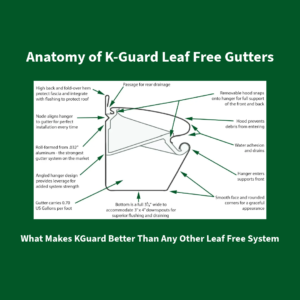
K-Guard’s patented system uses a curved aluminum hood with 2 channels that allow water to enter. No mesh, no screens, no inserts. Water flows into the gutter via surface tension; debris slides off the front edge onto the ground. The hood is slanted forward so that debris easily blows off and any ice that forms will build toward the front, not near the shingles. The trough is equivalent to a 6″ k-style gutter, making it a high-capacity system which handles Colorado’s heaviest snowmelt without overflow. Due to the larger size gutter and downspout, any debris that enters the gutter will be washed out of the system with a flushing action. There’s no maintenance schedule. K-Guard is Maintenance Free For Life. And it carries a lifetime transferable warranty that covers the guards and the gutters, which is important whether you’re planning to stay in your home or thinking about resale value down the road.
Stop Maintaining, Start Protecting
K-Guard Rocky Mountains installs a permanent, maintenance-free gutter system built specifically for Colorado homes. If you’re ready to stop climbing that ladder and eliminate gutter maintenance entirely, schedule a free quote with our team. We’ll evaluate your current system, show you exactly what maintenance-free means, and provide a written quote with no pressure to buy.