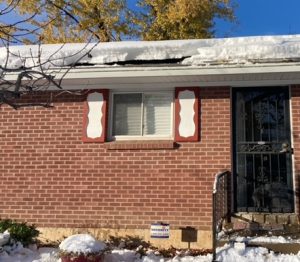
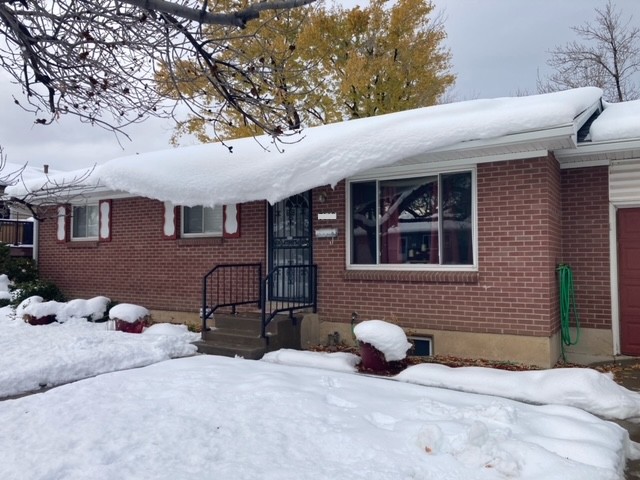
Why Solar Panel Snow Avalanches Destroy Gutters
You installed solar panels to save money on electricity. Now you’re watching hundreds of pounds of compacted snow and ice crash off those panels and bend your gutters like aluminum foil. It happens fast — one warm afternoon after a heavy snowfall, and suddenly your gutters are sagging three inches below the roofline, pulling fasteners out of the fascia board. A quick search online shows you’re not alone.
This isn’t a maintenance problem. This is a design mismatch. Standard residential gutters were engineered for rain and the occasional ice buildup. They were never built to absorb the impact force of a solar panel snow slide — and that’s exactly what’s destroying them. Click here to learn what maintenance your gutters do need.
What Makes Solar Panel Snow Slides Different
When snow accumulates on your roof, it melts slowly and unevenly. When snow accumulates on solar panels, it behaves completely differently. Solar panels are smooth, angled surfaces that heat up faster than asphalt shingles. When the sun hits those panels after a snowstorm, the snow doesn’t melt gradually — it releases all at once in a concentrated avalanche.
A typical residential solar array holds 200-400 pounds of snow after a six-inch Denver snowfall. When that snow slides, it doesn’t distribute evenly along your gutter system. It dumps in one spot, typically right below the lower edge of the panel array. Standard residential gutters are rated to handle static snow loads of 30-50 pounds per linear foot. They are not rated for dynamic impact loads of several hundred pounds hitting a three-foot section in under two seconds.
The damage pattern is predictable: bent gutter profiles, torn hangers, separated seams, and fascia boards that crack or split from the sudden force. Homeowners with roof-mounted solar in Colorado’s Front Range replace or repair gutters damaged by snow slides at roughly three times the rate of homes without solar panels.
Why Standard “Heavy-Duty” Gutters Still Fail
You might assume that upgrading to a thicker aluminum gutter or adding extra hangers would solve this. It doesn’t. The problem isn’t the gauge of the aluminum — it’s the way standard sectional gutters are constructed and installed.
Most residential gutters are sectional systems joined with slip connectors and sealed with caulk. Those seams are structural weak points. When a snow avalanche hits, the force travels through the gutter profile and concentrates at the seams. The caulk fails, the connectors separate, and the gutter pulls away from the house.
Even seamless aluminum gutters — which eliminate the joint problem — still rely on hangers/brackets spaced an average of 36 inches apart. When several hundred pounds of compacted snow hits a single point, those hangers act as pivot points. The gutter bends between the brackets. You end up with a gutter that looks like someone hit it with a sledgehammer, because functionally, that’s what happened.
The Real Cost of Repeated Gutter Damage
Replacing a damaged gutter section costs $8-12 per linear foot for materials and labor. If your solar array is causing repeated damage every winter, you’re looking at $400-800 in gutter repairs per season. Over the 25-year lifespan of your solar panels, that’s $10,000-20,000 in gutter replacement costs — more than many homeowners paid for the gutters in the first place.
But the bigger risk is what happens when you don’t repair the damage immediately. A bent gutter doesn’t drain properly. Water pools, overflows, and runs down your foundation wall. In Colorado’s freeze-thaw cycles, that water infiltrates foundation cracks, expands when it freezes, and causes structural damage that costs $4,000-10,000 to repair. A $600 gutter problem becomes a $6,000 foundation problem because you waited six months to fix it.
What a Gutter System Needs to Survive Solar Snow Loads
If you want gutters that can handle solar panel snow avalanches, you need a system designed with three specific features: structural reinforcement that distributes impact forces, a profile that resists bending under point loads, and a reliable and strong fastening method.
The gutter itself needs to be a continuous extrusion with no seams or joints. Seams are failure points. A snow avalanche will find them. The profile should be deeper and wider than standard residential gutters — not because you need more water capacity, but because a larger cross-section resists bending forces better than a shallow profile.
The fastening system is equally important. Instead of relying on brackets every 36 inches, the gutter should be secured continuously or with significantly closer spacing. Some commercial-grade systems use hidden hangers every 12 inches. Others integrate the fastening directly into the gutter extrusion so that the entire length of the gutter is supported, not just isolated points.
Finally, the system that works best will have a deliberate slope. A way to shed ice and snow buildup before it becomes a structural problem. A gutter installed dead-level — which is common with DIY installations and some budget contractors — will hold standing water that freezes, adding weight and creating its own set of problems.
Should You Add Snow Guards or Roof Heat Cables?
 Some solar installers recommend adding snow guards above your gutters to slow down snow slides. Snow guards work — they break up large avalanches into smaller releases — but they don’t eliminate the problem. You’re still getting impact forces; they’re just distributed over time instead of happening all at once. If your gutters are already borderline, snow guards might extend their life by a year or two, but they won’t solve the underlying structural issue.
 Roof heat cables are another option. These are electric resistance cables that melt snow before it can slide. They’re effective, but they can add $200-400 per year to your electricity bill — which defeats part of the purpose of installing solar panels in the first place. Heat cables also require annual inspection and maintenance. If a cable fails mid-winter and you don’t notice, you’re back to the same avalanche problem.
Both solutions address the symptom. Neither addresses the core issue, which is that your gutters aren’t strong enough for the application.
Next Steps for Homeowners with Solar Panels and Gutter Damage
- Document the damage with photos. If your solar installer made representations about snow management or gutter compatibility, you may have a warranty claim. Take clear photos of bent gutters, separated seams, and any fascia damage. This article has some pointers on inspecting your gutters, especially after a winter storm.
- Get a structural assessment from a licensed contractor. Before you replace the gutters, make sure the fascia board and roof decking aren’t compromised. If the fascia is cracked or rotted, it needs to be replaced first or your new gutters will fail just as quickly.
- Ask about the hanger system. Any contractor proposing a gutter replacement should be able to explain how their system distributes impact loads. If they’re proposing standard sectional gutters with 36-inch hanger spacing, they’re setting you up for the same failure cycle.
- Consider the long-term cost equation. A premium gutter system costs more upfront, but if it eliminates $500-1,000 in annual repairs. It pays for itself in 3-5 years. Over the life of your solar panels, the math heavily favors a permanent solution.
- Verify that your contractor has experience with solar homes. Not all gutter installers understand the specific load dynamics of solar panel snow slides. Ask for references from other homeowners with roof-mounted solar in your area.
The K-Guard Rocky Mountains Perspective
K-Guard’s gutter system was engineered to handle the weight of snow slides from solar panels. The design uses oversized aluminum extrusions with no seams and a fastening system that distributes loads across the entire gutter length instead of concentrating stress at individual hanger points. The hood is sloped forward, enabling snow and ice to slide from the roof and gutters, instead of accumulating. We’ve installed K-Guard on hundreds of Colorado homes with roof-mounted solar, and the system handles snow avalanches that would destroy standard residential gutters. The lifetime warranty covers the entire installation, including structural integrity under snow and ice loads. If you’re replacing gutters every few years because of snow slides, that’s not a maintenance issue — that’s a sign you need a different system.
Stop Replacing the Same Gutters Every Winter