
What You Should Be Looking at Right Now
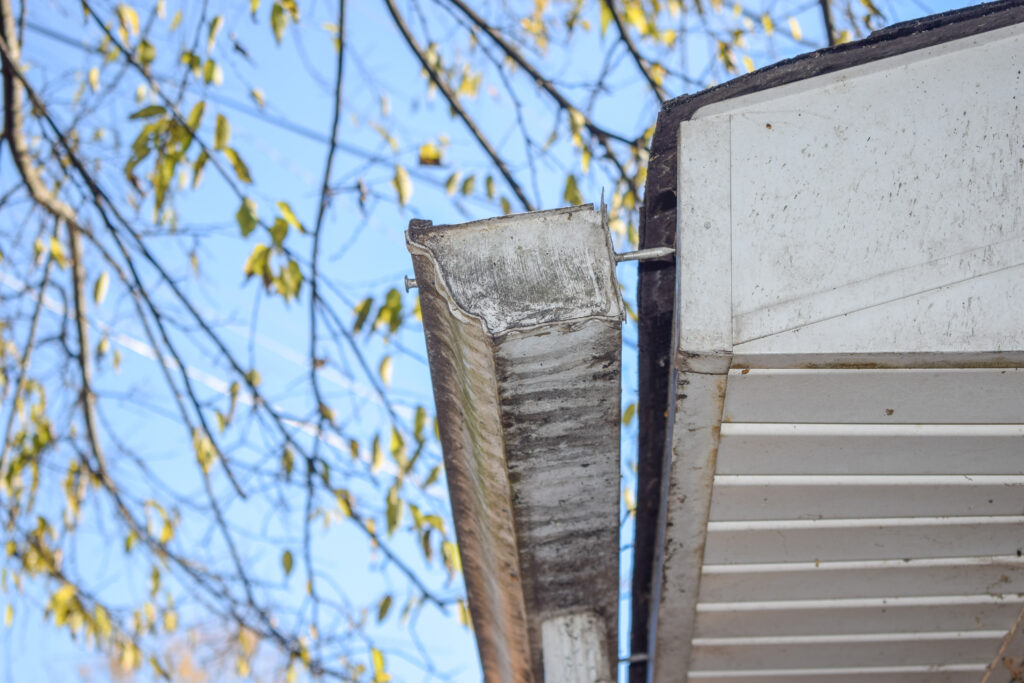
You know that feeling when the snow finally melts off your roof and you can see your gutters again? That moment when you realize they’re sagging in the middle, or there’s a gap between the gutter and the fascia board that wasn’t there in October?
Colorado winters are hard on gutter systems. The freeze-thaw cycles we get — where it hits 55 degrees one afternoon and drops to 18 that night — create forces that standard gutters aren’t designed to handle. Ice expands. Water backs up. Screws pull loose. And by the time March rolls around, you’re looking at damage that won’t announce itself until the next big storm sends water cascading down your foundation wall.
Winter Does More Damage Than You Think
Most homeowners assume winter is easy on gutters because there’s less rain. That’s backward. Winter is when the real stress happens.
When snow melts during the day and refreezes at night, any water trapped in your gutters expands by about 9%. That’s enough force to bend metal, pull fasteners out of fascia boards, and crack seams. If your gutters were already holding fall debris — pine needles, leaf matter, dirt — that debris acts like a dam. Water backs up behind it, freezes, and you’ve just created an ice block that can weigh 50-80 pounds per linear foot. That’s more than most systems can handle!
Standard builder gutters are attached every 24-36 inches with screws or spikes. When ice weight sits in there for weeks, those attachment points start to fail. The gutter tips forward. The back edge pulls away from the fascia. Once that happens, water no longer flows toward the downspout. Now it flows behind the gutter, along the fascia and straight down your exterior wall.
What to Check From the Ground
You don’t need to get on a ladder to spot most of things on this list. Walk your house perimeter. Use a pair of binoculars if you need help seeing the gutters. Here’s what you’re looking for:
Sag or slope changes. Stand 15-20 feet back and look at your gutter line against your roofline. It should run level or slope slightly toward the downspouts. If you see dips, waves, or sections that are visibly lower than others, that’s a sign the hangers have failed or the gutter itself has bent under ice load.
Gaps between gutter and fascia. Your gutter should sit tight against the fascia board along its entire run. If you see daylight, or if the back edge of the gutter is pulled away from the house, the fasteners are loose. This is the single most common post-winter failure point.
Standing water or staining. If you can see water pooled in the gutter a day or two after the last melt, it’s back-pitched. Water should drain completely within a few hours. Dark vertical streaks on your fascia or siding below the gutter mean water has been overflowing or leaking at seams.
Separated or damaged downspouts. Check where your downspouts connect to the gutter. Ice expansion can pop these joints apart. Also check the bottom of each downspout — if the outlet is bent, crushed, or disconnected from underground drainage, spring runoff will pool at your foundation. This article explores how that damages your foundation.
Underground Drainage: It’s Easy to Miss
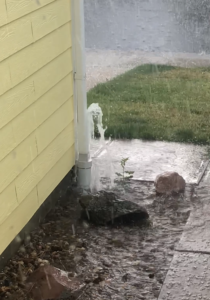
Your gutters are only half the system. The other half is where that water goes after it leaves the downspout. Most Colorado homes built after 1985 have underground drains — typically 4-inch corrugated pipe that runs from the downspout outlet to a pop-up emitter, an outlet on the street or a drywell 10-20 feet from the foundation. Underground drains require special attention.
These get clogged. Dirt, root intrusion, collapsed pipe sections, or freeze damage at the outlet can block the entire line. When that happens, water backs up, pools at your foundation, and you’re looking at basement seepage or foundation settling. Average repair cost for foundation water damage in the Denver metro area runs $6,000-$12,000.
Here’s how to check: Run water from a garden hose into each downspout for 3-5 minutes. Walk out to where the exit point should be. If water comes out cleanly, you’re good. If it doesn’t, or if water backs up at the downspout base, you’ve got a blockage. That needs to be cleared before spring storm season. In Colorado storm season is late April through June.
What Happens If You Don’t Fix This Now
Colorado’s spring weather pattern is predictable: heavy wet snow in March and April, followed by afternoon thunderstorms in May and June that can dump an inch of rain in 30 minutes. If your gutters are already compromised from winter damage, that’s when the real problems start.
A failing gutter doesn’t just drip. It channels hundreds of gallons of water directly to the spots where you don’t want it: foundation walls, window wells, crawl spaces. The cost to repair foundation cracks, replace rotted fascia boards, or remediate a wet basement will run you $3,000-$24,000 depending on severity. Compare that to the cost of addressing gutter issues now, which typically runs $200-$800 for repairs or $1,500-$3,500 for low end gutter replacement. Want more guidance on when to replace gutters? Click here.
And here’s the timing problem: late May and early June is cottonwood seed season. If your gutters are already damaged and then get packed with cottonwood fluff, you’re looking at complete blockage right when spring storms hit hardest.
When to Call a Professional vs. DIY
Some of this you can handle. Some of it you shouldn’t try.
You can do this yourself: Clearing visible debris from gutter troughs using a gutter scoop or leaf blower from the ground. Flushing downspouts with a hose. Tightening loose downspout straps. Re-sealing minor gutter seam leaks with gutter sealant (if you can reach them safely from a ladder).
Call a professional for: Anything that requires working on a ladder above 8-10 feet. Re-pitching gutters, this requires removing and resetting hangers, which most homeowners don’t know how to do correctly. Replacing pulled fascia boards or repairing rafter tail damage. Clearing underground drain blockages, this often requires a sewer snake or excavation. Any gutter section that shows rust-through, cracking, or separated seams longer than 6 inches.
If you’re seeing multiple problem areas — say, sagging in three spots, a separated downspout, and visible gaps at the fascia — you’re not looking at a repair situation. You’re looking at a system that’s reached end of life. Most builder-grade gutters last 10-15 years in Colorado conditions. Homes built in the late 1990s or early 2000s, are in that replacement window.
Conduct Annual Post-Winter Gutter Inspections:
- Walk your home perimeter. Check for sag, gaps, staining, and downspout connection issues. Take photos of anything that looks wrong. You’ll want them for contractor estimates.
- Test your underground drainage. Run a hose into each downspout and verify water exits cleanly. Mark any that don’t for follow-up.
- Clear any accessible debris now. Don’t wait for leaves and pine needles to combine with cottonwood seeds in May. The more you can remove before spring storms, the better your system will perform. And it’s much easier to clean the gutter trough than a clogged downspout. Better Homes & Gardens states that the average homeowner cleans their gutters twice a year, but not all homeowners have pine needles and cottonwood fluff to contend with!
- Get repair estimates before May. If you’re calling contractors, do it now. By late May, every gutter company in Colorado is booked solid with emergency calls from homeowners who waited.
- Consider whether this is a repair or replace decision. If your gutters are 15+ years old and showing multiple failure points, you’re going to spend $500-$1,200 on repairs that buy you maybe two more years. The math usually favors replacement at that point.
The K-Guard Rocky Mountain Perspective
We see hundreds of Colorado homes every spring where winter ice damage has pulled standard gutters loose or bent them out of pitch. The pattern is consistent: debris buildup from fall, ice formation in winter, failure points by March. K-Guard’s system uses a curved hood design that prevents debris entry, and eliminates the ice dam formation cycle. The system is also mounted with a high-strength hanger every 24 inches. It’s engineered to handle the weight of ice and snow load without pulling away from the fascia. That’s why we confidently back it with a lifetime transferrable warranty. We guarantee that KGuard gutters will never pull away from your home AND they will never clog!
K-Guard Rocky Mountain installs a permanent, maintenance-free gutter system built for Colorado homes. If you’re ready to stop climbing that ladder, click here to schedule a free quote.