
You’ve Been Cleaning Those Gutters for 18 Years. How Much Longer Will They Last?
If you installed builder-grade aluminum gutters when you moved into your home in the late 1990s or early 2000s, they’re approaching the end of their expected lifespan. You might not see it yet — no dramatic failures, no waterfalls pouring off the roof — but the clock is ticking. And in Colorado, where freeze-thaw cycles run from October through May and summer hailstorms punch dents into metal, that clock runs faster than it does in any other state.
Most homeowners don’t think about gutters until they fail. By then, you’re not just replacing gutters, you’re repairing fascia boards, repainting soffits, or worse, dealing with foundation settlement from years of poor drainage. Your gutters will eventually fail. Is it time to repair your gutters? Or do you need to replace them before they cause major issues for your home?
How Long Different Gutter Materials Actually Last?
That answer depends on what your gutters are made of and where in Colorado you live. We all know the weather can be dramatically different in the plains than the mountains. Here’s what the evidence says:
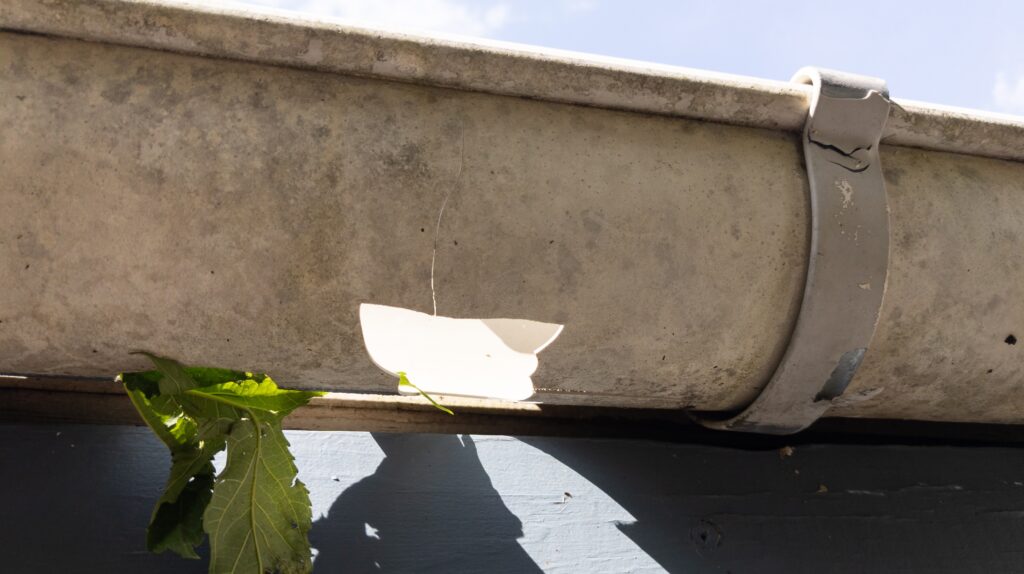
Aluminum gutters — the most common material on Colorado homes — typically last 20 years under normal conditions. But “normal” doesn’t include repeated freeze-thaw cycles, hailstorms that leave quarter-sized dents, or the kind of UV exposure you get at 5,280 feet. They won’t rust, but most aluminum gutters start showing serious wear between years 15 and 18. Fasteners pull away from the fascia, water starts pooling or even spilling over the front. If your gutters were installed before 2010, you’re in the replacement window.
Vinyl gutters — often chosen for budget-conscious installations — last 10 to 15 years at best. Colorado’s temperature swings are brutal on vinyl. The material becomes brittle in winter cold and warps in summer heat. Seams separate, the material cracks and brackets snap. If you have vinyl gutters older than 12 years, you’re on borrowed time.
Steel gutters — less common but still found on some older homes — rust. Period. Even galvanized steel starts to corrode after 15 to 20 years, especially where water pools or debris sits. Once rust takes hold, the deterioration accelerates quickly. You’ll see it first at seams and joints as rust colored water drops, then spreading across panels.
Copper gutters — the premium choice — can last 50 years or more. They patina instead of corrode, and they handle temperature swings without warping. But copper costs three to five times what aluminum does, which is why you rarely see it on newer homes.
Why Colorado Weather Shortens Gutter Lifespans
If you read manufacturer specs, they’ll tell you aluminum gutters last 20 to 25 years. But those estimates assume moderate climates. Colorado doesn’t qualify.
Our freeze-thaw cycles are relentless. Water trapped in gutters freezes overnight, expands, and stresses seams and fasteners. By morning it melts, only to freeze again the next night. This happens dozens of times each winter. Over 15 or 20 years, it’s like bending a paperclip back and forth until it snaps. Seams separate. Hangers pull loose. Metal fatigues.
Hail damage is the other major factor. A single severe hailstorm can dent aluminum gutters so badly that water pools instead of draining. Those pools sit there, breeding mosquitoes in summer, freezing solid in winter, and causing your gutters to fail more quickly than anticipated. Even if the gutters still technically work, the damage compounds every season.
Then there’s UV exposure. At our altitude, ultraviolet radiation is 25% more intense than at sea level. Over two decades, that UV breaks down paint finishes, weakens sealants, and makes gutters more prone to oxidation. You’ll see it as chalky white residue on dark gutters or as sections that look faded compared to protected areas.
Signs Your Gutters Are at the End of Their Life
Some gutter problems are repairable. Others are warning signs that the entire system is failing. Here’s how to tell the difference:
Repairable issues — worth fixing if your gutters are less than 12 years old:
- One or two loose hangers that can be refastened
- A single separated seam that can be resealed
- Minor clog-related overflow that stops after cleaning
- A damaged downspout section that can be replaced independently
End-of-life indicators — signals that replacement makes more financial sense than repair:
- Multiple seams separating along the same gutter run
- Rust spots or corrosion visible from the ground
- Gutters sagging even after hangers are tightened
- Water stains on fascia boards or soffits — evidence of chronic overflow
- Visible cracks in the gutter trough itself
- Peeling paint that exposes bare metal underneath
- Gutters pulling away from the house despite being fastened
If you’re seeing three or more of these signs, you’re past the point where patching makes sense. A contractor can temporarily seal a seam or replace a hanger, but you’ll be calling them back in six months for the next failure. At that point, you’re paying for repairs on a system that’s structurally compromised.
Why Replacement Makes More Financial Sense After 15 Years
Here’s the math to consider: if your gutters are 15 to 18 years old and you’re spending $300 to $800 per year on repairs, cleanings, and water damage mitigation, you’ll spend that same amount — or more — over the next three to five years while the system continues deteriorating.
A full gutter replacement costs between $1,500 and $3,000 for a typical single-story home, or $3,000 to $6,000 for a two-story home or one with complex rooflines. That sounds like a lot until you compare it to foundation repairs ($4,000 to $10,000), fascia board replacement ($1,000 to $2,500), or interior water damage remediation ($2,000 to $8,000). Every year you delay replacing failing gutters, you increase the risk of one of those bigger bills.
There’s also the ladder factor. If you’re climbing up twice a year to clean gutters that are nearly 20 years old, you’re maintaining a system that’s already lived most of its useful life. The effort doesn’t extend the lifespan — it just postpones the inevitable. And the older you get, the less appealing that ladder becomes.
What to Look for in Gutter Replacement
If you’re replacing gutters that lasted 18 or 20 years, the natural question is: can you install something that lasts longer? Or better yet, something that eliminates the maintenance cycle entirely?
Standard aluminum gutters will give you another 15 to 20 years, assuming similar conditions. But if what failed them the first time was clogging, ice dams, or poor drainage during heavy snowmelt, the same problems will return. You’re resetting the clock, not solving the underlying issue.
Seamless gutters — formed on-site from a single piece of aluminum — eliminate the seams where most leaks develop. That’s an improvement. But they still clog, still require cleaning, and still suffer from Colorado’s freeze-thaw cycles.
Gutter guards— mesh screens, foam inserts, or brush-style filters — reduce debris accumulation but don’t eliminate it. Most still require periodic cleaning to remove fine particles that slip through or accumulate on top. And many void your gutter warranty or roofing warranty depending on how they are installed.
The other option is a fully enclosed gutter system — one that promises never to clog or pull away. K-Guard’s patented design uses a curved hood that channels water into a large-capacity trough while keeping leaves, pine needles, and cottonwood seeds out. No mesh to clog. No inserts to maintain. The system is designed to handle Colorado’s high-volume spring runoff and eliminate the ice dam formations that damage standard open gutters.
Because the entire system is seamless and uses heavy-gauge aluminum, it’s built to outlast standard gutters by a significant margin. And it carries a lifetime transferable warranty which matters if you’re thinking about resale value on your home.
Evaluating Your Gutter’s Lifespan
If your gutters are approaching 15 years old — or if you’re seeing multiple signs of failure — here’s what to do:
- Document what you’re seeing. Take photos of sagging sections, separated seams, rust spots, or water damage on fascia boards. This gives you a baseline and helps contractors assess the scope of work needed.
- Calculate what you’ve spent on maintenance. Add up gutter cleaning costs, minor repairs, and any water damage remediation over the past three years. If it’s approaching $1,000 or more, replacement is likely more cost-effective than continuing to patch.
- Get a professional assessment. A reputable gutter contractor can tell you whether your system has two years left or two months. Ask them to show you specific failure points and explain what’s repairable versus what’s structural.
- Consider the full cost of failure. Foundation repairs, fascia replacement, and interior water damage all cost multiples of what gutter replacement costs. Waiting too long doesn’t save money, it just shifts where you spend it.
- Evaluate your maintenance tolerance. If you’re tired of cleaning gutters twice a year and you’re planning to stay in your home for another decade or more, a maintenance-free system pays for itself in time saved and risk eliminated.
The K-Guard Rocky Mountain Perspective
We install gutter systems on homes all over Colorado and we see the same patterns again and again. Seams fail first. Then hangers pull loose. Then water starts running behind the gutters and rotting the fascia. The homeowners kept cleaning them, kept patching them, and kept hoping they’d last a few more years. By the time they call us, they’re not just replacing gutters. They’re repairing the damage those gutters caused. Our perspective: if your gutters are old enough to vote, it’s time to replace them. And if you’re going to replace them, install something designed to outlast you, not just outlast the warranty period.
K-Guard Rocky Mountain installs a permanent, maintenance-free gutter system built for Colorado homes. If your gutters are approaching end-of-life and you’re ready to stop patching a failing system, schedule a free quote with our team.