Is There a Big Difference Between Sectional Gutters and Seamless Gutters?
You’ve probably stood in your driveway on a rainy afternoon and watched water drip steadily from a seam in your gutter. Not overflowing, just leaking straight through the joint. That’s not a clog. That’s not a maintenance issue you can’t fix with a ladder and a garden hose. That’s a structural failure, and it’s costing you every time it rains.
Sectional gutters will leak. The question is when, and how much damage they’ll cause before you replace them. We take our gutters for granted, so who knows how long the issue will last before you notice damage. In our freeze-thaw climate, damage occurs faster than most homeowners expect. Which is why most Colorado Homeowners are done with sectional gutters.

What Are Sectional Gutters and Why Do They Fail
Sectional gutters are exactly what they sound like: pre-cut sections of gutter material — typically 10 feet long — joined together with connectors, sealant, and hardware. They’re the standard choice for big-box home improvement stores because they’re easy to transport, easy to stock, and easy for DIY installers to work with.
The problem is the joints. Every connection point is a potential leak, and Colorado’s weather doesn’t give those joints much of a chance. When temperatures swing from 65°F in the afternoon to 15°F overnight (something that happens dozens of times between October and April) the metal expands and contracts. The sealant hardens, cracks, and eventually fails. Water finds the gaps.
Once a seam starts leaking, it doesn’t stop. Water drips widening the gap. It can also get behind the fascia board, soaking into the wood, starting the slow process of rot. By the time you notice the damage, you’re not just replacing a gutter section. Now you’re replacing trim boards, repainting, and dealing with mold in the attic.
How Seamless Gutters Are Different
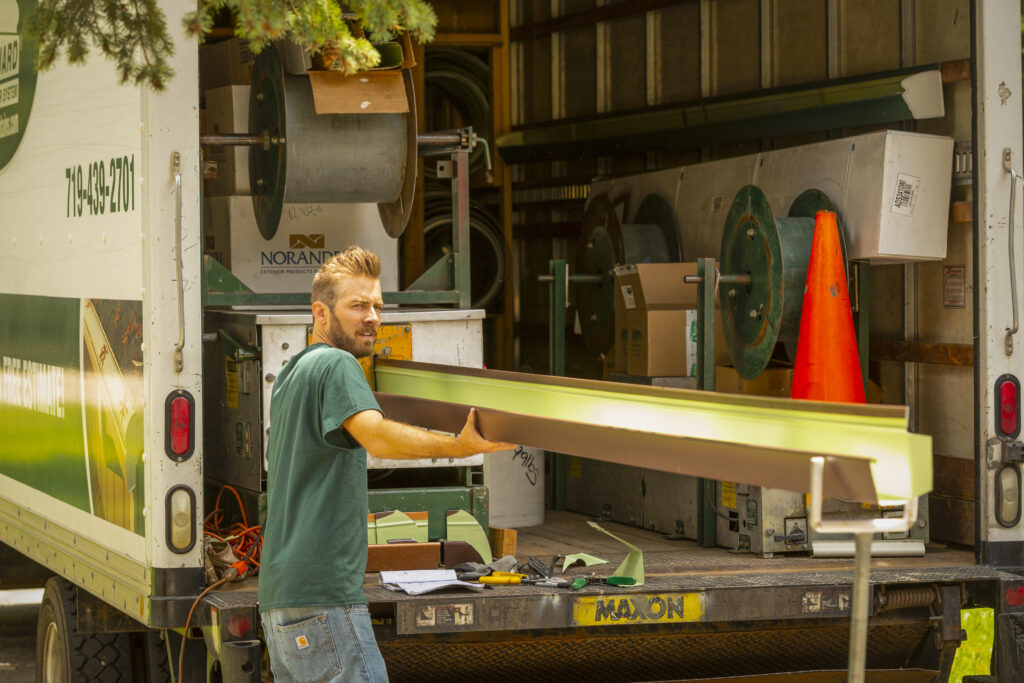
Seamless gutters are roll-formed on-site using a portable machine that creates continuous sections custom-fitted to the exact length of your roofline. No joints along the runs. No connectors. No seams except at the corners and downspout outlets, places where proper flashing and caulking can create a permanent seal.
The material itself is typically heavier-gauge aluminum than sectional gutters, which means it holds its shape better under snow load. In Colorado, where spring snowstorms can dump 12-18 inches overnight, that makes a huge difference. A sagging gutter doesn’t just look bad. It redirects water toward your foundation instead of away from it.
Here’s what separates seamless from sectional in real-world performance: seamless gutters don’t rely on sealant to keep water inside the channel. The gutter is one continuous piece of formed metal. Water has nowhere to leak except through the material itself, and aluminum doesn’t corrode in the way that joint hardware does.
Freeze-Thaw Cycles and Gutter Seams
Colorado homeowners deal with 80-100 freeze-thaw cycles per year on average, more in the foothills, fewer on the plains, but enough everywhere to cause problems. Freezing water expands. That expansion force in a gutter joint is approximately 1,700 pounds per square inch. Sealant and connector hardware aren’t built to withstand that kind of stress repeatedly.
Sectional gutters fail at the seams first. You’ll see rust stains on the fascia and water marks on the foundation. Eventually separation will be visible where the sections used to connect. By year five or six, you’re either re-sealing every joint annually or accepting that your gutters leak.
Seamless gutters eliminate that failure point. The corners still need attention; but you’re maintaining two or three joints instead of ten or twenty. The difference in long-term durability is measurable: properly installed seamless gutters in Colorado regularly last 20-25 years without structural failure. Sectional systems rarely make it past 12-15 years before needing replacement.
Maintenance Differences You’ll Actually Notice
Sectional gutters require more than cleaning. You’re inspecting every joint for separation, checking sealant for cracks, tightening hardware that’s worked loose from expansion and contraction, and replacing connectors that have rusted through. That’s not something you knock out in an afternoon.
Seamless gutters still need cleaning. Leaves, pine needles, and cottonwood seeds don’t care what kind of gutter you have, but the structural maintenance is minimal. You’re checking slope and making sure downspout connections are secure. Not re-sealing, replacing connectors and chasing leaks every 10 feet.
The time difference matters if you’re the kind of homeowner who handles your own maintenance. The cost difference matters if you’re hiring it out. Most gutter contractors charge $150-$300 per visit, and sectional systems often need attention twice as often as seamless systems just to stay functional.
Let’s Do A Cost Breakdown
Sectional gutters cost less upfront. You’ll pay $5-$10 per linear foot installed, depending on material quality and contractor rates in your area. Seamless gutters run $10-$18 per linear foot installed, with the higher end reflecting heavier-gauge material and more complex rooflines.
That’s a real difference on a 150-foot installation: $750-$1,500 for sectional versus $1,500-$2,700 for seamless. But the cost comparison doesn’t end at installation. Over a 15-year period, here’s what most homeowners actually spend:
- Sectional gutters: $700-$1,500 initial install + $1,200-$2,400 in repairs and re-sealing + $1,200-$1,800 for replacement at year 12-15 = $3,100-$8,800 total
- Seamless gutters: $1,500-$2,700 initial install + $0-$400 in minor repairs = $1,500-$3,100 total
Those calculations don’t include the cost of water damage if a seam fails and you don’t catch it immediately. Foundation repairs in Colorado average $4,000-$10,000. Fascia board replacement runs $15-$30 per linear foot. One unnoticed leak can erase any savings you thought you were getting with sectional gutters.
Why Seamless Is the Standard for Colorado’s Climate Extremes
Colorado’s weather doesn’t give you the luxury of “good enough.” We manage snowmelt runoff in March and April that can dump 2-3 inches of water equivalent in a single day. Annual hailstorms turn gutters into Swiss cheese. Our temperature swings would wreck infrastructure in any other state.
Seamless gutters aren’t a premium option here. They’re the baseline for durability. Contractors who work in this climate full-time don’t install sectional systems on their own homes. That should tell you something.
The freeze-thaw cycle is the deciding factor. If you lived in Arizona or Southern California, sectional gutters might last. In Denver, Aurora, or anywhere along the Front Range, they’re fighting a losing battle from day one.
How Do You Determine Which is Best: Seamless vs. Sectional Gutters
- Inspect your current gutters during the next rainfall. Look specifically at the seams. If you see water dripping from joints rather than flowing toward downspouts, you’re witnessing a failure point first hand. This needs attention!
- Calculate your actual cost over time, not just installation cost. Factor in repairs, re-sealing, and eventual replacement. Seamless gutters cost more upfront but less over the life of the system.
- Consider how long you plan to own the home. If you’re staying another 10-15 years, seamless gutters pay for themselves. If you’re selling in two years, sectional might be adequate, but it won’t add resale value the way a quality seamless system does.
- Ask any contractor you’re considering what they install on their own properties. If they’re pitching you sectional gutters but using seamless at home, you have your answer.
- Get at least two estimates and compare material specs, not just price. A cheap seamless gutter using thin-gauge aluminum isn’t better than a quality sectional system. You’re looking for heavier-gauge seamless with properly sealed corners.
The K-Guard Rocky Mountain Perspective
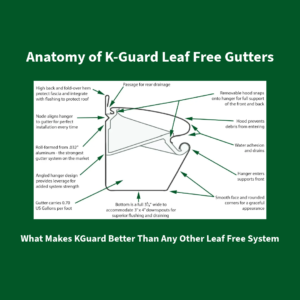
We install seamless gutters exclusively because we’ve seen what Colorado weather does to sectional systems. But here’s what most homeowners don’t realize: even seamless gutters still need cleaning, still accumulate debris, and still clog if you have mature trees nearby. That’s why K-Guard’s system goes a step further — seamless aluminum construction with a patented hood that keeps debris out. No cleaning. No clogs. No seams along the runs. It’s built specifically for climates like ours, where failure isn’t an option and maintenance shouldn’t be a recurring expense.
Ready to Eliminate Gutter Problems Permanently?
K-Guard Rocky Mountain installs a permanent, maintenance-free gutter system built for Colorado homes. If you’re ready to stop climbing that ladder and stop worrying about seam failures, schedule a free quote with our team. We’ll assess your drainage needs, and show you exactly what it takes to protect your home for at least the next 50 years.