
Clogged Gutters Can Lead to Five Figures in Foundation Damage
You’ve owned your home for decades. You know which sprinkler heads need adjusting every spring, which windows stick in summer, and exactly where the driveway cracks reappear after winter. But here’s what most homeowners in the Denver area don’t realize until it’s too late, the biggest threat to your foundation isn’t soil movement or tree roots — it’s six inches of standing water in your gutters during a May thunderstorm.
When gutters clog and overflow, water doesn’t just disappear into your lawn. It pools against your foundation, saturates the soil, and begins a process that can cost you $4,000 to $10,000 or more to repair. In Colorado, where we experience freeze-thaw cycles from October through April, that damage accelerates faster than in most other states.
What Actually Happens When Water Pools Next to Your Foundation
When your gutters overflow, whether from cottonwood seeds in June, pine needles in October, or ice dams in February, the water falls directly alongside your home’s perimeter. A single inch of rain on a 2,000-square-foot roof produces over 1,200 gallons of runoff. Without functional gutters to channel that water away from your foundation, it goes straight down.
The soil around your foundation absorbs that water and expands. Clay soil, common throughout Colorado, can swell up to 10% when saturated. That expansion creates what engineers call hydrostatic pressure. The soil literally pushes against your foundation walls. Pressure that your concrete foundation was never designed to withstand.
Then winter arrives. Water trapped in saturated soil freezes and expands further; up to 9% more volume. That freeze-thaw cycle repeats dozens of times between November and March. Each cycle creates micro-fractures in your foundation. Over several seasons, those hairline cracks widen into structural problems.
The Early Warning Signs You May Be Missing
Foundation damage from clogged gutters doesn’t announce itself with a catastrophic failure. It shows up quietly, in ways most homeowners attribute to normal settling or age. You might notice doors that suddenly stick in their frames during spring, that’s often foundation movement, not humidity. Cracks that appear at the corners of window frames, especially after a wet season, indicate the same thing.
Walk your basement or crawl space after a heavy rain. Do you see moisture on the walls? Dark staining near the floor? These aren’t cosmetic issues. They’re evidence that water is penetrating your foundation. By the time you see water actively seeping through foundation walls, you’re already looking at significant repair costs.
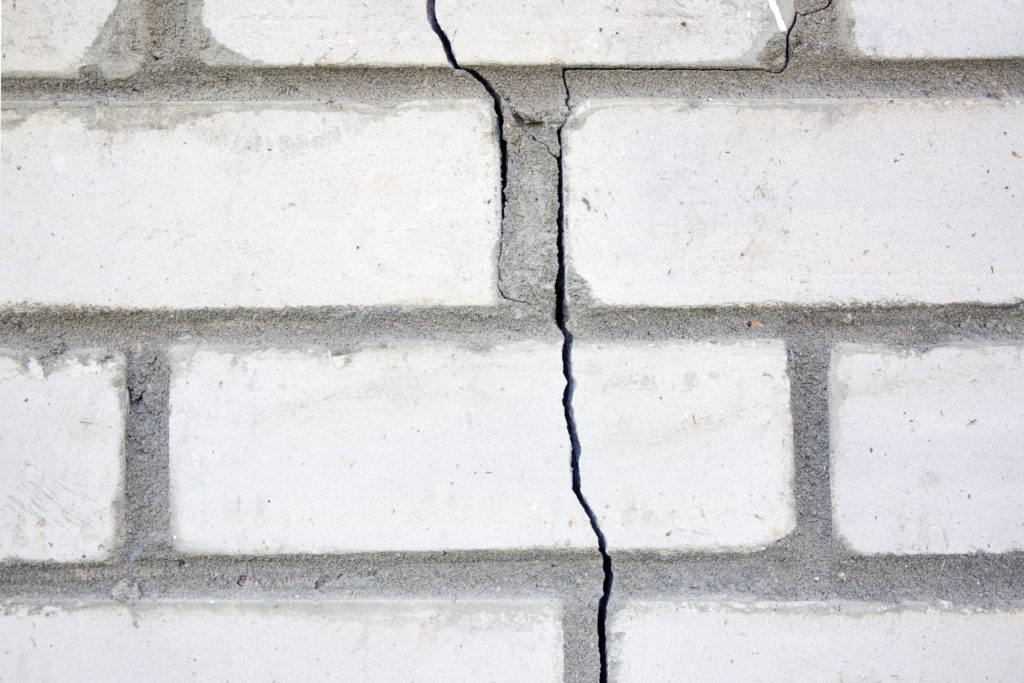
Here’s what foundation contractors see consistently in Colorado homes: horizontal cracks in poured concrete foundations, stair-step cracking in concrete block foundations, and bowing or tilting walls. All three patterns trace back to the same cause — sustained hydrostatic pressure from water that should have been carried away by functional gutters.
What Foundation Repairs Actually Cost in the Denver Area
Foundation repair companies don’t give rough estimates. They give you exact quotes based on the severity of damage. Minor crack repair starts around $2,000, but that’s rarely where the problem ends once water has been pooling for multiple seasons. Carbon fiber reinforcement for bowing walls runs $4,000 to $8,000. Steel pier underpinning to stabilize a settling foundation costs $10,000 to $15,000 or more, depending on how many piers your home needs.
Those numbers don’t include any interior repairs. If water has penetrated your basement, you’re also paying for mold remediation, drywall replacement, flooring, and any belongings that were damaged. Homeowners insurance may cover sudden water damage from a burst pipe, but gradual damage from poor drainage? That’s considered maintenance neglect — you’re paying out of pocket.
The longer foundation damage goes unaddressed, the more expensive it becomes. What starts as a $3,000 crack repair in year one becomes a $12,000 structural repair in year three because the problem compounded while you waited. And if you’re thinking about selling, foundation issues either kill the deal entirely or come off your sale price dollar-for-dollar.
Why Colorado’s Climate Makes This Worse Than Other States
Denver receives an average of 14 inches of precipitation annually, which sounds modest until you consider how it arrives. We get intense spring storms that drop an inch or more in an hour. We get heavy, wet spring snow that melts rapidly when temperatures swing from 20°F to 60°F in two days. That melt-and-freeze pattern is murder on foundations.
The Front Range sits at an elevation of 5,000 to 6,000 feet. Our freeze-thaw cycle is longer and more severe than lower-elevation cities. Water freezes, expands, thaws, and refreezes dozens of times each winter. If your gutters aren’t working — if they’re clogged with pine needles from fall or ice-dammed from inadequate drainage — that water sits against your foundation through every cycle.
Homes built in the 1970s and 1980s, common in established Denver neighborhoods, typically have builder-grade gutters that were never sized for Colorado storm events. Those 4-inch gutters overflow during heavy rain, even when clean. Add cottonwood debris, and they’re backing up by mid-May. Your home deserves better than what the original builder installed forty years ago.
What You Can Do Right Now to Protect Your Foundation
Start with an honest assessment. When was the last time you cleaned your gutters? If the answer is “I can’t remember,” then it’s likely time to get them cleaned. If you’re paying someone to clean them but they’re clogged again three months later, you don’t have a cleaning problem. You have a system problem. Standard gutters with screens or foam inserts still clog. The debris just sits on top of the insert instead of inside the gutter, and water still overflows.
Walk your property after the next heavy rain. Stand back and watch where water is flowing. If you see waterfalls pouring over gutter edges, if you see erosion patterns in your landscaping near the foundation, if your downspouts are dumping water within three feet of your house, you’re creating the conditions for foundation damage.
Check your downspout extensions. Water needs to discharge at least four to six feet away from your foundation; farther if you’re on sloped terrain. Those flexible corrugated extensions you see at hardware stores are better than nothing, but they disconnect, get run over by mowers, and degrade quickly in our harsh weather conditions. Buried drainage systems work if they’re installed correctly and don’t clog.
Consider the full cost of your current approach. If you’re paying $200 for gutter cleaning three times per year, that’s $600 annually. Over ten years, that’s $6,000 spent on a recurring expense that doesn’t solve the underlying problem, and that doesn’t account for the foundation damage that’s still occurring while you wait between cleanings.
Next Steps for Protecting Your Foundation
- Inspect your gutters after the next rainfall. Look for overflow patterns, sagging sections, and any visible debris buildup that’s blocking water flow.
- Examine your foundation perimeter for early warning signs: cracks wider than 1/8 inch, moisture staining, soil erosion, or pooling water that doesn’t drain within 24 hours.
- Verify your downspouts discharge at least four feet from your foundation and that water flows away from your home, not toward it.
- Calculate what you’re currently spending on gutter cleaning annually and project that cost over the next decade of homeownership.
- If you’re seeing any warning signs or if your current gutters require cleaning more than twice yearly, schedule a professional evaluation before the next wet season.
The K-Guard Rocky Mountain Solution
We’ve assessed foundation damage on hundreds of Colorado homes, and the pattern is always the same — failed gutters, saturated soil, and expensive repairs that could have been prevented. K-Guard’s patented hood design keeps debris out while handling the high water volume from Colorado storms. Our 6-inch gutter systems are engineered for the precipitation patterns we actually see here, not what builders anticipated in 1978. The system carries a lifetime transferable warranty because it’s designed to be the last gutter system your home ever needs. That’s not marketing language. That’s how we’ve operated since 1996.
K-Guard Rocky Mountain installs a permanent, maintenance-free gutter system built for Colorado homes. If you’re ready to stop climbing that ladder and protect what you’ve invested in your home, schedule a free quote with our team at 303-351-2100 or visit kguardrockymountain.com.
Related Articles
If you want to go deeper on this topic, we recommend the following articles: