What To Expect When a Gutter Crew Shows Up at Your House for Installation
You’ve signed the contract. The installation date is on your calendar. And now you’re wondering what actually happens when the K-Guard crew pulls up to your home at 8 a.m. on a Tuesday morning.
If you’ve owned your home for decades, you’ve probably been through contractor projects before. You know that “one day” can stretch into three, that “minor adjustments” can mean jackhammering at 7 a.m., and that cleanup sometimes means a pile of debris left in your driveway with a promise to “swing by tomorrow.” So when someone tells you a full gutter replacement will be done in a single day, you’re right to ask: what does that actually look like?
The Gutter Installation Process Matters More Than You Think
Most homeowners focus on the end result — gutters that don’t clog, a system that handles Colorado snowmelt without overflowing. But how the work gets done determines whether that system performs the way it’s supposed to for the next 30 – 60 years.
Standard builder gutters are assembled from pre-cut sections, sealed at the joints, and hung with brackets spaced wherever the installer thinks they’ll hold. When those seams fail or those brackets pull away from the fascia during a heavy spring storm, it’s because the installation process cut corners you never saw.
K-Guard’s installation follows a specific sequence designed to eliminate the two most common failure points: seams and inadequate support. The process isn’t faster because we rush. It’s faster because the system is engineered to go together correctly the first time.
What Happens Before Installation Day
A good gutter installation starts before the truck arrives. During your evaluation appointment, the specialist measures every linear foot of roofline, notes where downspouts will drain, and identifies any fascia damage that needs attention before new gutters go up. This isn’t a quick walk-around with a tape measure. It’s a detailed assessment of how water moves off your roof during a storm.
If your home was built in the late 1970s or early 1980s, there’s a decent chance the fascia boards behind your current gutters have some rot. Colorado’s freeze-thaw cycles are hard on wood, especially where gutters have been overflowing for years. A responsible installer flags this long before the new gutters are installed. But the specialist has pointed out any areas of concern as well.
You’ll also receive a timeline estimate based on your home’s size and complexity. A single-story ranch with straightforward rooflines typically takes 6-8 hours. A two-story home with multiple roof valleys and a detached garage can run 8-10 hours. If the crew says they’ll be done by mid-afternoon, they mean it.
The Morning Your Gutters Get Installed
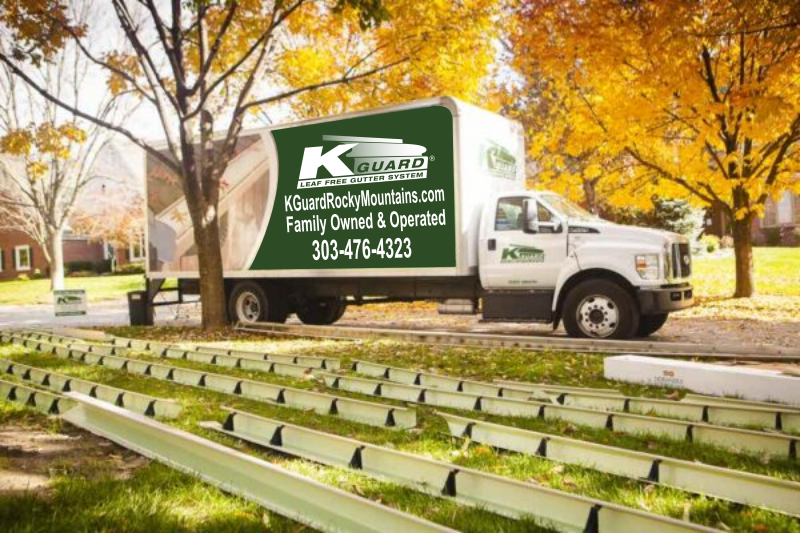
The crew arrives with everything they need: ladders, safety equipment, a gutter-forming machine mounted in a truck, brackets, screws, sealant, and tools. They don’t need to run to the hardware store mid-job.
First step: removing your old gutters. This sounds simple until you realize how many nails and screws are holding 150 feet of metal to your house. The crew detaches downspouts, unfastens brackets, and carefully pulls the old system away from the fascia. If your old gutters are aluminum, they’ll be recycled. If they’re vinyl or steel, they go to the appropriate disposal site. Steel will be recycled where available, but you won’t be left with a tangle of scrap metal in your driveway.
Once the old gutters are down, the fascia gets inspected up close. Minor rot gets addressed. Loose boards get re-secured. If there’s significant damage that wasn’t visible from the ground, the crew supervisor walks you through it and explains what needs to happen before gutters go up. This is where a detailed pre-installation assessment pays off — major surprises are rare.
How Seamless Gutters Are Formed On-Site
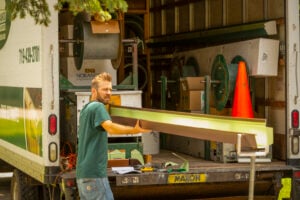
Here’s where K-Guard’s process differs from standard gutter installation. Instead of hauling pre-cut sections to your home and piecing them together with seams every 10 feet, the crew forms gutters in continuous runs using a roll-forming machine mounted on the truck.
This machine takes flat aluminum coil and shapes it into K-Guard’s patented profile — a deeper, wider gutter with an integrated hood that blocks debris while channeling water. For a 40-foot section of roofline, you get one 40-foot piece of gutter. No seams. No joints where leaks can develop five years from now.
The color you selected during your estimate is the color that comes off the machine. K-Guard’s finish is baked on, not painted, so it won’t chip or peel the way builder gutters often do after a few Colorado hail seasons. Need help picking a color? This article has some suggestions.
Bracket Spacing and Why It Matters in Colorado
Standard gutter installations typically space brackets 30 to 36 inches apart. That’s fine in climates where gutters carry light rain a few times a month. In Colorado, where spring snowmelt can dump gallons of water per minute into your gutters, that spacing isn’t enough.
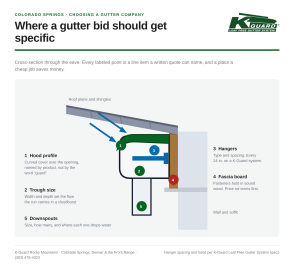
K-Guard installs brackets every 24 inches. Each bracket is screwed directly into the fascia board and rafter tail with stainless steel fasteners, not nails that can work loose over time. This isn’t overkill. It’s what’s required to support the extra weight of water during peak runoff, the ice that forms when temperatures drop overnight and the heavy spring snow falls. You will always get new brackets installed, never re-used.
The crew uses a level at every bracket to ensure proper pitch. Water needs to flow toward downspouts at a consistent grade — typically 1/4 inch per 10 feet. Too much pitch and water overshoots corners. Too little and it pools, creating ice dams in winter.
Downspout Placement and Drainage
Downspouts go where water needs to go, away from your foundation. The crew positions them at corners and intervals that prevent any gutter section from holding standing water. Each downspout gets secured to the wall with brackets and directed to drain at least 4 feet from the foundation, either via extensions or into existing drainage systems.
If your property slopes toward the house or if you have basement window wells near downspout locations, the crew adjusts placement or adds extensions to protect those areas. This matters more than most homeowners realize. Foundation water damage from poor downspout drainage averages $4,000 to $10,000 to repair in Colorado.
Fitting, Sealing, and Final Adjustments
Once all gutter sections are up and downspouts are in place, the crew performs end-cap installation and final sealing. This is also when the patented hood is installed on the system. K-Guard’s system uses a continuous hood that locks into place along the entire run. There’s no mesh that lifts in high winds, no inserts that shift over time.
The hood is also inconspicuously secured to the brackets, tacked into place to prevent heavy winds from lifting the hood.
Cleanup and Final Walkthrough
A professional installation includes cleanup. The crew hauls away old gutters, sweeps up metal shavings from the gutter-forming process, and picks up fasteners and brackets that didn’t make it into the system. They also run a magnet over the area to catch any loose screws or nails. Your yard should look the way it did that morning, minus the old gutters.
Before they leave, the crew supervisor walks you through the completed installation. They show you the finished product and ask if there are any changes that are need. They discuss the process and answer any questions about maintenance (spoiler alert: there isn’t any) or what to watch for during the next storm.
How Long Does Gutter Installation Actually Take?
For most single-story homes in Denver and surrounding areas, expect 6 to 8 hours from arrival to cleanup. A typical ranch-style home built in the late 1970s with 120 to 150 linear feet of roofline fits this timeline.
Two-story homes with multiple roof valleys, dormers, or complex rooflines take longer — usually 8 to 10 hours. If your home has a detached garage or a significant amount of fascia damage that needs repair, add time accordingly.
Most times, the crew doesn’t leave until the job is complete unless weather forces a stop. K-Guard schedules installations with enough buffer time to complete the work in one visit whenever possible. The day the office calls to schedule your installation, they will discuss with you the arrival time for the crew and the expected time frame for your specific installation. You will be informed at that time if your job is expected to take more than a single day.
Next Steps for Your Gutter Installation
- Ask about fascia condition during your evaluation— if there’s rot, you want to be sure it’s addressed before new gutters are installed.
- Confirm the timeline — most homes take one day, but get a specific estimate based on the specifications for your home.
- Clear access to the perimeter of your home — move patio furniture, planters, and anything within 6 feet of the house.
- Plan to be home for the final walkthrough — this is when you ask questions and confirm the system is working correctly.
- Understand the warranty terms — K-Guard’s lifetime transferable warranty covers materials and performance, which matters for you and any future homeowners.
The K-Guard Rocky Mountains Perspective
We’ve installed gutters on hundreds of Colorado homes over the past two decades, and the questions homeowners ask before installation day are almost always the same: How long will this take? Will my yard be torn up? What happens if something goes wrong? The answer to all three is straightforward: one day, no, and we will always defer to you if something unforeseen arises during your installation. K-Guard’s has the installation process down to a science. The variables that turn a simple job into a multi-day headache are eliminated during our evaluation process. The system is engineered to go together correctly, the crew is trained to install it the same way every time, and the result is gutters that work the way they’re supposed to for as long as you own your home.
K-Guard Rocky Mountains installs a permanent, maintenance-free gutter system built for Colorado homes. If you’re ready to stop climbing that ladder, schedule a free evaluation today.