
Cottonwood Seeds Are More Than Annoying – They’re Destructive
You’ve seen it happen. Mid-May rolls around, and suddenly your driveway looks like it’s covered in snow — except it’s 72 degrees outside. Cottonwood seeds. They collect in your window wells, stick to your car, and if you haven’t checked your gutters in the last two weeks, they’ve already turned your downspouts into solid plugs.
Most Colorado homeowners know cottonwood season is annoying. What they don’t realize is how much damage those seeds can do to a gutter system in less than three weeks. By the time you notice water spilling over the edge during a June thunderstorm, you’re no longer dealing with a simple cleaning job.
Cottonwood Seeds Create the Worst Gutter Clogs of the Year
Cottonwood season in Colorado runs roughly from mid-May through early June, depending on when spring temperatures stabilize. The timing matters because it overlaps with two other conditions that make the problem worse: late-season snowmelt and early monsoon storms that can drop an inch of rain in 20 minutes.

Here’s what makes cottonwood seeds different from fall leaves. Leaves are bulky. They sit on top of gutter guards or pile up in a gutter, until they block water flow. You can see them from the ground. Cottonwood seeds, on the other hand, are fine, fibrous, and sticky. When they get wet, they compress into a dense mat that acts like felt. Once that mat forms inside your gutter channel or across a mesh screen, water can’t penetrate it. Your gutters stop draining entirely, sometimes in less than a week.
If your home is anywhere near mature cottonwood trees (for neighborhoods built in the 1970s and 1980s that’s most homes) you’re dealing with thousands of seeds landing on your roof every day for three to four weeks straight. They collect in valleys, behind chimneys, and they wash straight into your gutters with the first rain.
Mesh Gutter Guards Make the Problem Worse
Some homeowners, tired of dealing with cottonwood cleanup have already tried gutter guards — either the foam inserts, the plastic screens that snap onto the gutter edge, or the fine metal mesh that promises to keep out “even pine needles.” Click here if you want to know why pine needles are a problem.
Those guards work fine when you’re dealing with oak leaves. They fail completely during cottonwood season, and here’s why: cottonwood seeds weave into mesh. The finer the mesh, the faster it clogs. Once the seeds get wet, they bind to the surface and create a waterproof barrier. Rain hits the mesh, sheets off the edge, and your gutters might as well not be there.
We’ve seen homeowners spend $1,500 on professionally installed micro-mesh guards, only to call us two years later because they’re up on the ladder every May scrubbing cottonwood paste off the screens with a wire brush. That’s not a gutter guard. That’s a $1,500 seasonal maintenance project.
What Happens When Gutters Fail During Spring Runoff
The consequences of clogged gutters don’t wait until you notice them. In Colorado, late May and early June are peak runoff months. Snowmelt combines with spring storms, and your roof is channeling more water than it will at any other point in the year except maybe during a summer hailstorm.
When gutters overflow during this period, that water doesn’t just spill onto your landscaping. It runs down your foundation walls, saturates the soil around your basement, and creates hydrostatic pressure against your foundation. If you have an older home — anything built before 1990 — your foundation likely has hairline cracks already. Water intrusion turns those into active leaks.
Foundation water damage repairs in the Denver area start around $4,000 for minor crack sealing and waterproofing. If you’re dealing with structural movement, interior flooding, or mold remediation, you’re looking at $10,000 or more. And here’s the part that matters to someone like you: your homeowner’s insurance typically doesn’t cover gradual water damage caused by what they consider poor maintenance. If an adjuster determines your gutters were clogged and you didn’t address it, that’s on you.
There’s also the ice dam risk. Cottonwood clogs that are still there in December when snow accumulates on your roof and starts to melt, that water has nowhere to go. It backs up under your shingles, refreezes overnight, and creates an ice dam. We’ve seen ice dams cause $15,000 in roof and interior water damage to homes in Aurora — all because a cottonwood clog from six months earlier was never cleared.
What You Can Do About Cottonwood Season — Three Options
You have three realistic options for dealing with cottonwood season in Colorado.
Option One: Clean Your Gutters Yourself in Late May and Again in Early June. If your home is single-story, your knees and balance are solid, and you don’t mind spending four hours on a ladder with a hose and a scoop, this works. Budget for two cleanings during cottonwood season alone; one around May 20th and another around June 10th. You’ll also need at least one fall cleaning and a spring cleaning after pine pollen season. That’s four trips up the ladder per year, minimum.
Option Two: Hire a Gutter Cleaning Service Seasonally. Professional gutter cleaning in the Denver area runs $150 to $300 per visit depending on your home’s size and pitch. If you’re paying for two cottonwood cleanings, two fall cleanings, and one spring cleaning, you’re spending $750 to $1,500 per year. That’s $7,500 to $15,000 over ten years. It solves the immediate problem, but it doesn’t solve the underlying issue — you still have a gutter system that requires constant maintenance.
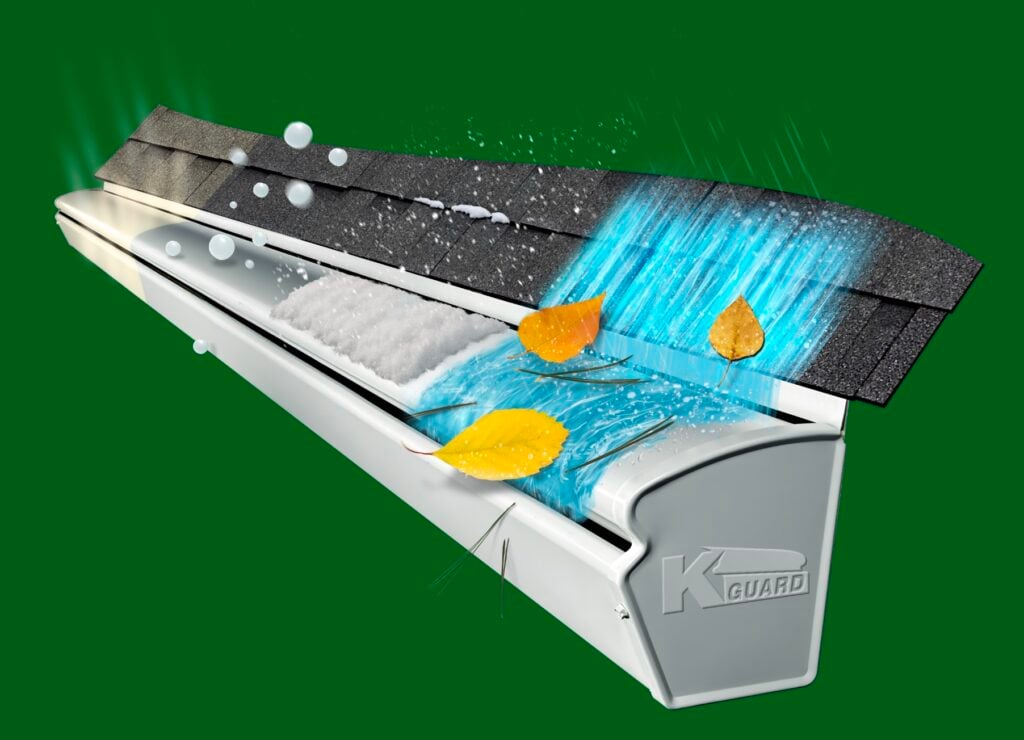
Option Three: Install a Gutter System That Doesn’t Clog. This is the option most homeowners don’t know exists. A properly designed gutter guard system — and we’re talking about a recurve metal hood-style system, not mesh — prevents most cottonwood seeds from entering the gutter channel in the first place. Water flows in through a narrow opening along the front edge. Seeds, leaves, and pine needles wash over the hood and fall to the ground. Any debris that does get inside, gets flushed away with the next rain. You can learn more about those differences in this article: KGuard vs. Gutter Screens and Filters.
Next Steps for Cottonwood Season Gutter Protection
- Assess Your Current System Before Peak Season. If you haven’t cleaned your gutters since last fall, do it now — ideally in early May before cottonwood starts flying. Check for existing clogs, sagging sections, and rust spots. If your gutters are already compromised, cottonwood season will make it worse.
- Don’t Install Mesh Guards as a Cottonwood Solution. If a contractor is recommending micro-mesh or foam inserts specifically for cottonwood, find a different contractor. Those systems do not solve the cottonwood problem — they relocate the cleaning task from inside the gutter to the top of the screen.
- Evaluate the Ten-Year Cost of Maintenance. Add up what you’re spending annually on gutter cleaning or what your time is worth if you’re doing it yourself. Multiply that by ten years. Now compare it to the cost of a permanent solution. For most homeowners, a one-time investment in a maintenance-free system pays for itself in under seven years.
- Look for a Gutter System Designed for High-Volume Water Flow. Colorado storm events can drop significant rainfall in short periods. Your gutter system needs to handle not just cottonwood seeds, but also the water volume from a summer thunderstorm or a spring snowmelt surge. Standard builder gutters are typically 4 inches. Look for 5-inch or 6-inch systems with a high-capacity design.
- Ask About Warranty Transferability. If you’re planning to stay in your home long-term, a lifetime warranty matters. If you might sell in the next decade, ask whether that warranty transfers to the next owner. A transferable warranty adds value to your home and gives buyers one less maintenance item to worry about.
The K-Guard Rocky Mountains Perspective
We install a recurve metal hood-style gutter system specifically because of cottonwood season. The K-Guard design uses a curved hood that uses surface tension to allow water to flow in while deflecting seeds, leaves, and pine needles over the edge. There’s no mesh to clog, no screen to scrub, and no inserts to remove and replace. We’ve installed this system on hundreds of homes in Colorado and the difference during May and June is immediate — homeowners stop calling us about overflow problems because there’s nothing left to clog. The system carries a lifetime warranty, it handles Colorado’s storm volume, and it’s built to outlast your roof.
Ready to Stop Dealing with Cottonwood Season?
K-Guard Rocky Mountain installs a permanent, maintenance-free gutter system built for Colorado homes. If you’re ready to stop climbing that ladder every May, schedule a free quote with our team. We’ll assess your home’s specific water flow challenges and show you exactly how a recurve hood-style system eliminates cottonwood clogs for good.