When the Sky Opens Up: Hails Effect on Your K-Guard System
You’re standing at your front window watching quarter-sized hail bounce off your driveway, thinking ‘what this is going to cost me?’. The car in the garage is safe. The roof — well, that’s why you have insurance. But what about those gutters you just invested in?
What actually happens when hail hits your gutters: usually nothing you need to worry about (Do you know the different hail threat levels?). But let’s walk through the specifics, because you didn’t spend money on a gutter system just to worry about it.
What Hail Actually Does to Gutter Systems
Standard aluminum gutters — the ones most home builders install — dent. That’s just physics. A half-inch hailstone traveling at terminal velocity carries enough energy to leave visible divots in thin-gauge metal. Those dents don’t always compromise function immediately, but they create weak points that accelerate wear and can trap debris over time.
The bigger problem isn’t cosmetic. When hail damages the seams or hangers on traditional gutters, you get leaks. Water starts dripping behind the gutter, soaking the fascia board. By the time you notice the staining, you’re looking at wood rot repair bills that dwarf the cost of the gutters themselves.
K-Guard’s system uses heavier-gauge aluminum than builder-grade gutters. .032 inches thick to be precise. Much thicker than the .019-.025 inch material on standard gutters. That extra thickness matters when hail season arrives in May and June, and again during those surprise September storms that catch everyone off guard. Gutter coil thickness is explained more in-depth in this article.
The Colorado Hail Reality
Colorado sits in what insurance companies call “hail alley.” The Front Range sees an average of 9-12 hail events per year, with the most severe storms typically hitting between April and September. Most of these produce pea-to-marble-sized hail. The storms that make the news — the ones dropping golf balls or larger — happen about once every 2-3 years in any given neighborhood.
Here’s what matters for your gutters: it’s not the single catastrophic storm that causes the most damage. It’s the accumulated impact of dozens of smaller events over 10, 15, 20 years. Standard gutters gradually weaken. Seams separate. Hangers pull loose. You don’t wake up one morning to find them destroyed — you just notice one day that they’re sagging, leaking, and need replacement.
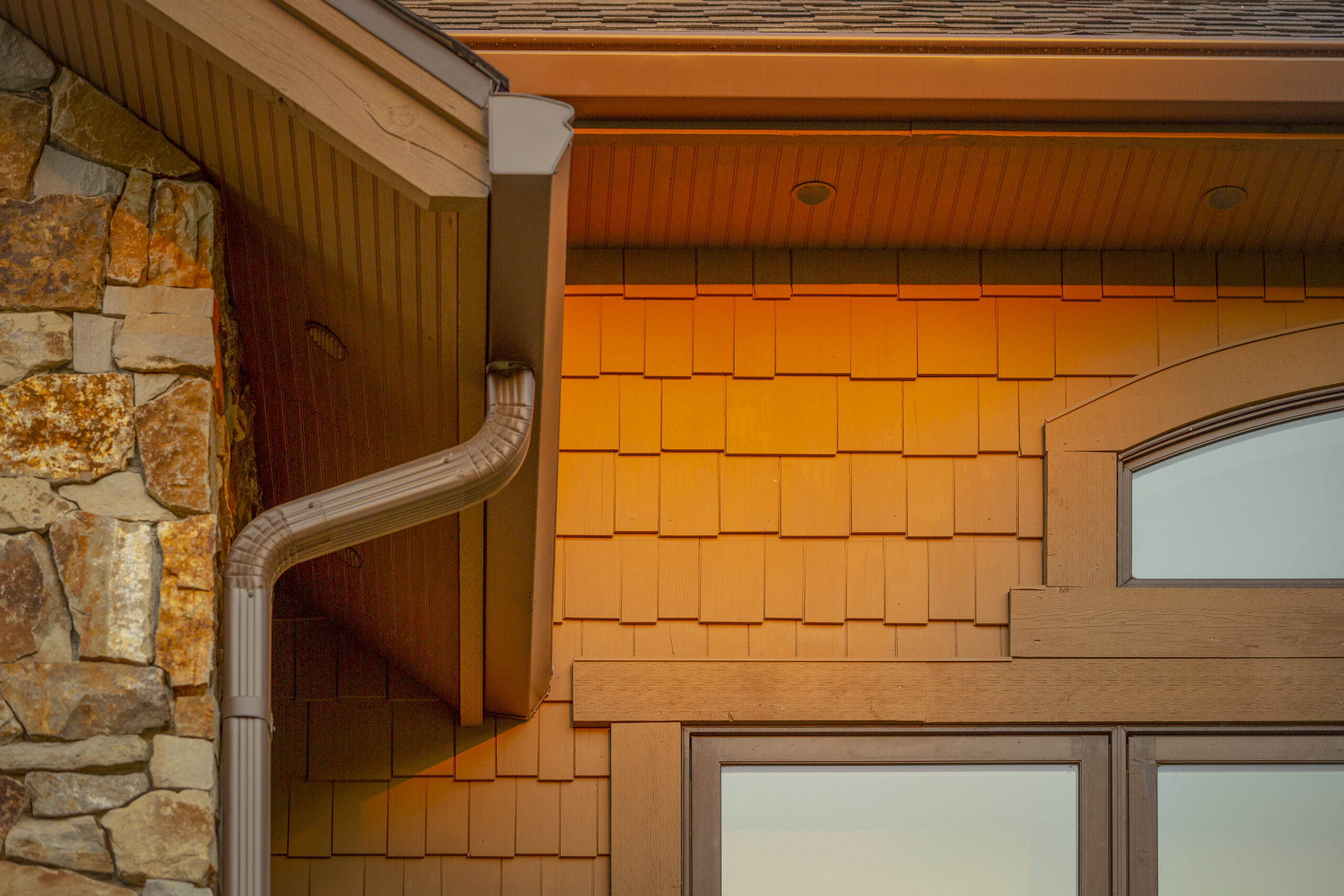
K-Guard’s system addresses this with three specific and unique design features. The covered hood protects the gutter trough itself from direct impact. The heavy-gauge aluminum resists denting from all but the most severe hail. And the internal hangers — hidden inside the system rather than screwed through the front lip — don’t create the same weak points that cause traditional gutters to pull away from the fascia after repeated hail strikes.
What the Warranty Actually Covers
K-Guard Rocky Mountain backs every installation with a lifetime transferable warranty. That covers the system against defects in materials with a promise that your gutters will never pull away and never clog for as long as you own your home. This guarantee transfers to the next owner if you sell. If your K-Guard system ever pulls away from the fascia, clogs or has paint finish malfunctions as the result of normal wear and tear, then call us. We come out and fix the issue, free of charge, no questions asked!
Hail damage is referred to as an ‘act of god’ by insurance companies. Meaning it’s more destructive than normal wear and tear. If a storm is damaging enough to cause the K-Guard system to fail functionally — meaning it can no longer channel water properly or has pulled away from your home — then your homeowner’s policy will cover the replacement of your system, or at the very least, the affected sections. More importantly, if your home was hit with a storm that was strong enough to functionally damage .032 aluminum, then you will likely have other damage concerns as well.
Most homeowners never need to file a claim for their K-Guard gutters. The system is engineered to handle typical Colorado weather events without functional damage. But in the rare case of a truly catastrophic hail event — the kind that totals cars and requires roof replacement — your K-Guard system is protected the same way the rest of your home is: through your homeowner’s insurance policy.
What to Check After a Hail Storm
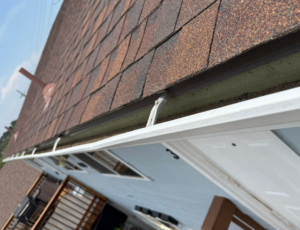
Walk your property after any significant hail event and look for these specific issues. First, check that water still flows freely through your downspouts during the next rain. If you notice a backup, standing water in the gutter or overflow, call for an inspection — something may have shifted.
Second, look at the hangers where the gutter attaches to your fascia. The photo to the left shows an example of what some hangers look like. You’re checking for gaps or separation. K-Guard’s internal hanger system makes this easy — if you see daylight between the gutter and your home, that’s worth a call.
Third, watch how water moves across the hood during the next rainstorm. The system is designed to handle sheet flow across the curved surface. If water is overshooting or pooling in specific areas, the hood may have been impacted hard enough to affect the water adhesion.
Most of the time, you won’t find any of these issues. The system just keeps working. But it’s worth 10 minutes of your time to check, especially after storms that damaged other homes in your neighborhood.
How K-Guard Compares to Other “Hail-Resistant” Systems
You’ll see gutter guard products marketed as “hail-proof” or “impact-resistant.” Here’s what those terms usually mean: they’re slightly thicker than the cheapest options, or they use a polymer coating that resists visible denting.
K-Guard doesn’t market itself as hail-proof because nothing is truly hail-proof in a state where baseball-sized hail falls from the sky. Instead, the system is built to maintain function through weather events that would destroy or compromise lesser systems. The covered design protects the water channel. The heavy-gauge material resists deformation. The internal hangers stay secure when external brackets would pull loose.
The practical difference shows up 5, 10, 15 years after installation. Other systems start sagging, leaking at seams, or requiring repairs. K-Guard systems installed in the 1990s are still channeling water properly on homes across the Denver metro area. That’s not marketing — that’s the difference between engineering for Colorado weather and engineering for the national average.
Next Steps for Protecting Your Investment
-
- Document your K-Guard installation date and keep warranty paperwork in your home maintenance file — you’ll want it accessible if you ever need service or if you sell your home.
- After major hail events, do a quick visual inspection of your entire gutter system, looking for separation, overflow during rain, or obvious deformation. Don’t want to inspect them yourselves? Give us a call and we’ll come give a free system evaluation: 303-476-4323. Or read this article for some inspection tips
- If you notice any functional issues — water not draining, sections pulling away, overflow at specific points — contact K-Guard Rocky Mountain directly rather than attempting DIY repairs that could void your warranty.
- Keep your homeowner’s insurance current and understand your deductible — in the rare event of catastrophic damage, your gutters are covered as part of your home’s exterior
- Don’t assume cosmetic denting means functional failure — minor dimpling doesn’t always affect water flow. If you aren’t sure if the damage you see requires immediate action, reach out and ask us to come take a look.
The K-Guard Rocky Mountains Perspective
We’ve installed thousands of systems across the Front Range, and we’ve seen them weather some of the worst hail storms in Colorado history. The 2017 storm that hit Golden and Lakewood. The 2023 event that damaged half the roofs in Highlands Ranch. Our systems come through these events doing exactly what they’re designed to do: channel water away from your foundation without requiring ladder time or maintenance calls. When we say lifetime warranty, we mean it — because we built the system to last that long in this climate.
K-Guard Rocky Mountain installs a permanent, maintenance-free gutter system built for Colorado homes. If you’re ready to stop worrying about what the next storm will cost you, schedule a free quote with our team.