
Colorado Guide to Gutter Guards and Snow
You don’t want to deal with gutter cleaning, clogs, or other problems, so you finally bought gutter guards. Then last February, you watched ice build up along your roofline while water backed up under your shingles. By March, you had a stain spreading across your dining room ceiling. The guards were supposed to prevent problems.
Unfortunately, gutter guards that work perfectly in autumn can fail catastrophically in winter. Those guards are doing their best, but the physics of frozen water meeting debris that’s already trapped inside your guards or any kind of colder surface will lead to ice everytime.
Why Standard Gutter Guards Fail Under Snow Load
Most gutter guard systems rely on mesh, perforated metal, or foam inserts that sit inside or on top of your existing gutters. They work reasonably well for dry leaves. They fail predictably under three Colorado winter conditions.
First, let’s examine snow accumulation. A cubic foot of fresh snow weighs roughly 4-7 pounds. Wet, compacted snow? Closer to 20 pounds per cubic foot. Your average 30-foot section of gutter with standard mesh guards isn’t built to withstand the weight of snow. The brackets will start pulling away from your fascia. Most builder-grade gutter systems use brackets spaced roughly 36 inches apart, rated for maybe 30-40 pounds each. That’s not promising math.
Second, freeze-thaw cycles. Denver sees an average of 22 days per winter where the temperature crosses the freezing point. Water melts during the day, drains toward your gutters, then refreezes at night. Gutter guards are cooler than the air around them. Water sits on top of them, freezes, and creates an ice dam that blocks all subsequent melt, causing the ice to continue getting bigger. The system that was supposed to keep water flowing actually traps it.
Third—and this catches most people off-guard—the debris is already there. You installed guards to avoid cleaning, so you stopped checking your gutters. Pine needles, cottonwood seeds, and roof grit accumulated underneath the mesh over two seasons. Now that debris is frozen solid, anchored in place, blocking the actual gutter channel while snow piles up on top of the guard. You don’t have a gutter system anymore. You have an elevated trough full of ice.
What Ice Dams Actually Cost Colorado Homeowners
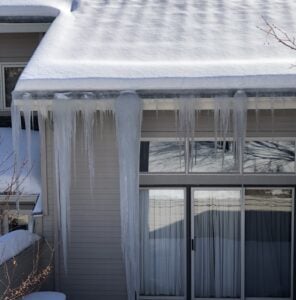
Ice dams form when trapped water freezes along your roofline and forces subsequent melt back up under your shingles. The average ice dam repair—including water damage to insulation, drywall, and framing—runs $4,000 to $12,000. That’s after your insurance deductible.
Most homeowner policies cover sudden water damage but exclude damage from “lack of maintenance.” If your insurance adjuster determines that clogged or inadequate gutters caused the ice dam, you may be fighting that claim.
Beyond the immediate damage, ice dams signal a deeper problem: your gutter system cannot handle Colorado’s winter water load. That’s not a maintenance issue. That’s a design failure. Standard five-inch K-style gutters with aftermarket guards were never engineered for the snow-to-melt ratio we see along the Front Range.
The foothills see it worse. Homes in Evergreen, Conifer, and Castle Rock deal with higher snow loads, more pine needle debris, and steeper freeze-thaw swings. A system that barely functions in Aurora will fail completely at 7,500 feet.
How Snow Load Reveals the Real Difference Between Gutter Systems
The question isn’t whether gutter guards work in snow. The question is which design survives the combined stress of weight, ice, and debris without trapping water against your home.
Systems that sit inside your gutters—foam inserts, brush-style guards—compress under snow weight and hold moisture like a sponge. They’re breeding grounds for ice formation.
Mesh and perforated metal systems create a flat surface where snow can pile up indefinitely, a process that stops water from entering your gutter entirely, once those holes freeze over.
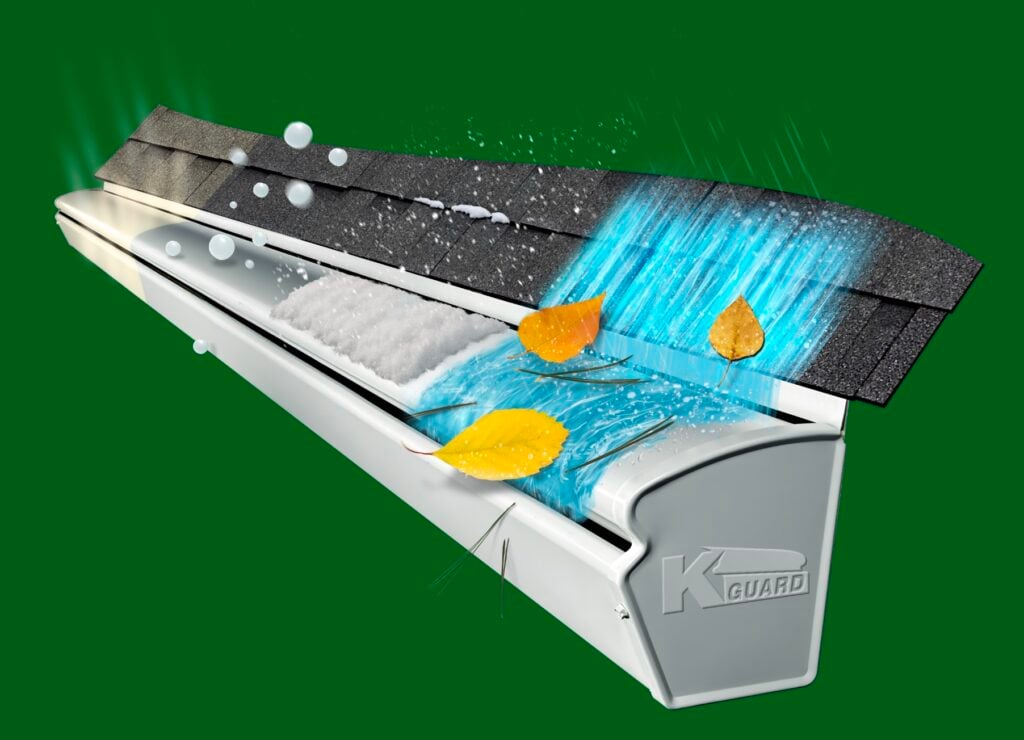
The only design that consistently handles Colorado winters is a curved hood system with no mesh, no perforations and no flat surface to trap water. Water follows the curve into an oversized channel while snow and ice slide off the front edge and brackets that are engineered specifically to support the significant load.
K-Guard’s system, for example, uses brackets rated at 75 pounds each, spaced every 24 inches. The curved hood has no mesh, no screen, and no flat surface for snow accumulation. It’s the equivalent size of a six-inch gutter—30% to 50% larger than builder standard—because volume matters when you’re channeling spring snowmelt off a 2,000-square-foot roof.
What to Look for in a Winter-Rated Gutter System
If you’re evaluating gutter guards for a Colorado home, ask these questions before you sign anything:
Can the system handle freeze-thaw cycles without trapping water? If there’s mesh, there’s a failure point. Period. Water will freeze in the mesh, block drainage, and force subsequent melt back toward your roof.
What’s the bracket load rating, and how far apart are they spaced? You want brackets rated for at least 60-75 pounds, installed every 18-24 inches maximum. Anything less will sag or pull loose under a typical Denver snowfall.
How much water volume can the gutter handle during peak melt? Standard five-inch gutters move about 1,200 gallons per hour at capacity. A six-inch system moves 2,000+ gallons per hour. When three feet of snow melts off your roof over two days in April, that difference matters.
Is there a warranty that covers winter performance specifically? Most mesh guard warranties exclude ice damage. If the company won’t stand behind winter performance and don’t offer any solutions in writing, they fail to acknowledge it’s a weak point.
What happens if debris does get in? No system is literally maintenance-free forever. But if you need a ladder and a pressure washer to regularly clean guards that were supposed to eliminate cleaning, you’ve solved nothing. What does the company say will happen if debris becomes an issue?
Next Steps for Winter-Proofing Your Gutter System
- Inspect your current system before the next snow. Look for sagging sections, loose brackets, or visible debris. If your guards are mesh or foam, expect problems once temperatures drop.
- Calculate your actual snow load capacity. Measure your gutter length, check your bracket spacing, and verify load ratings. Most systems installed by general contractors aren’t rated for what Colorado winters deliver.
- Evaluate whether your gutters are large enough. If you have standard five-inch gutters on a roof larger than 1,500 square feet, you’re undersized for spring melt—especially if you’re in the foothills.
- Don’t confuse “works in summer” with “works in winter.” Most gutter guard reviews are written in September. Read specifically for ice dam performance and winter water damage claims.
- Get a quote from a company that engineers for snow load specifically. Ask about bracket ratings, channel size, and winter performance guarantees. If they don’t bring those up unprompted, keep looking.
The K-Guard Rocky Mountain Perspective
We install gutter systems in Denver, Castle Rock, and all along the Front Range specifically because standard solutions fail here. Our patented curved hood design has no mesh to freeze shut, and our brackets are rated at 75 pounds each—more than double what most guards can handle. The system is oversized on purpose. We’ve watched too many homeowners deal with damage caused from undersized gutters to install anything less. It’s a lifetime transferable warranty because we know it holds up. If you’re done gambling on systems that fail every February, we’d be happy to show you why this one is built to perform in the snow.
K-Guard Rocky Mountain installs a permanent, maintenance-free gutter system built for Colorado homes. If you’re ready to stop climbing that ladder, schedule a free estimate with our team.