Covered gutters and add-on gutter guards both promise to keep leaves out of your gutters, but they get the job done in different ways. A covered system is built and installed as one unit, with the cover, channel, brackets, and downspouts all going up together. An add-on guard is a cover that is fastened onto the gutters you already have, so the old metal, seams, and spikes stay on your house underneath it.
That difference matters on the Front Range, because the gutter under the cover still has to move the water from a July cloudburst and hold up under a spring snowmelt. Here’s how to compare the two before choosing which to install.
What you’re buying with each option
Add-on gutter protection comes in several types. The K-Guard comparison page lists the common ones: mesh screens, foam inserts, bottle brush inserts, reverse curve covers, surface tension covers, snap-on covers, and perforated covers. Each one sits on top of or inside an existing open gutter. Some clip to the front lip, some slide under the first row of shingles, and some screw down to the gutter itself.
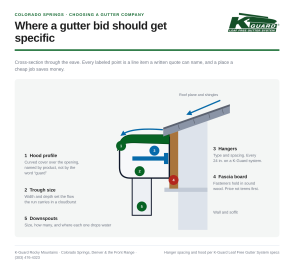
A covered system, instead, replaces the whole assembly. The K-Guard Leaf Free Gutter System is formed seamless on site from heavy-duty, non-corrosive aluminum, with a curved hood built straight into the gutter. Its patented all-weather polymer hangers sit every 24 inches and support that hood, according to the K-Guard Rocky Mountains site.
| Question | Covered one-piece system | Add-on guard on existing gutters |
|---|---|---|
| What gets installed | New gutter, cover, brackets, and downspouts together | A cover or insert on the current gutter |
| Gutter size and seams | Chosen for your house at install | Whatever is already up there |
| Support | New brackets set with the system (every 24 inches on K-Guard) | Existing spikes or brackets stay |
| Downspouts | New, sized with the gutter (3×4 inch on K-Guard) | Existing ones stay |
| Written warranty covers | The full system, per the maker’s terms | Often the guard only, so read the terms |
K-Guard facts in the table come from the company home page and product page. The add-on column describes how those products install, so check any brand’s written terms.

An add-on guard keeps the problems your old gutter already has
If your gutters are sound and sized right for your house, an add-on guard can be a reasonable step. Most homeowners start shopping for gutter guards after years of overflow, sagging, or leaking seams, though, and a cover won’t change any of those.
Check the age of the gutter first. InterNACHI, the home inspectors’ association, lists aluminum gutters at 20 to 40 or more years on its life expectancy chart. Plenty of homes around Denver, Aurora, and Lakewood still have gutters older than that. Fastening a new cover to worn metal means you’re paying to protect something that may need replacing soon.
Watch your gutters from the ground on a rainy afternoon before deciding anything. Look for water pouring over the front edge while the gutter looks clear, and drips from the corners or end caps. Spikes backing out of the fascia and standing water after the rain stops are warning signs too. Each of those is a sizing, support, or pitch problem, and a guard would just sit right on top of the problem.
How much water your gutters have to move in a Denver storm
Capacity requirement is the part most gutter guard comparisons miss. Denver rain tends to fall in short, intense bursts. The Mile High Flood District’s Urban Storm Drainage Criteria Manual puts the peak five minutes of a Denver 2-year storm at 2.77 inches per hour. A 10-year storm peaks at 4.43 inches per hour.
You can turn those rates into gallons per minute for your own house. One inch of rain on one square foot is about 0.62 gallons. Spread over an hour, each square foot sends roughly 0.0104 gallons per minute into the gutter for every inch per hour of rain. The table below shows that math for a 1,000 square foot section of roof draining to one gutter run.
| Denver storm (5-minute peak) | Rainfall rate | Water off 1,000 sq ft of roof |
|---|---|---|
| 2-year | 2.77 in/hr | about 29 gallons per minute |
| 5-year | 3.63 in/hr | about 38 gallons per minute |
| 10-year | 4.43 in/hr | about 46 gallons per minute |
| 25-year | 5.63 in/hr | about 59 gallons per minute |
| 100-year | 7.70 in/hr | about 80 gallons per minute |
Rates come from the Mile High Flood District Denver values. Flow is roof area times rate times 0.0104.
An add-on guard doesn’t make the gutter under it any bigger. Screens and mesh add a surface the water has to pass through, and anything that mats on that surface sits right where the water needs to go. Our gutters and downspouts run about 40% larger than other guard systems, as stated on our home page. The product page adds that 45 by 45 degree inside corners remove the choke points where debris collects.

How pine needles, cottonwood, and roof grit behave on each design
Front Range debris is a mix of pine needles, cottonwood fluff, maple and aspen leaves, and the granules that wash off asphalt shingles. On a screen or mesh cover, light material can settle on top and sit there until wind or rain moves it. The K-Guard gutter covers comparison notes this can mean occasional cleaning.
A curved hood works differently. Water follows the curve into a narrow opening, while leaves and needles slide off the front edge, as the K-Guard product page describes. Nothing collects in a filter surface because there isn’t one.
Snow and ice: what either design can and can’t do
No gutter can stop snow from piling up or keep ice from forming on a Colorado roof, and a company that says otherwise is overselling. What you can control is how well the gutter holds its shape under the load and whether meltwater has a clear path out.
That’s where bracket spacing matters. On K-Guard gutter systems, the polymer hangers fully support the hood and keep the gutter from sagging. An add-on cover rides on whatever spikes or brackets your old gutter has, so be sure to check them before a heavy snow year. For eaves with a known icing problem, K-Guard Rocky Mountains also offers heat cable support, listed on our comparison page.

Covered gutters: questions to ask a gutter company before you sign
Whichever way you lean, get the answers in writing:
- What gutter and downspout size are you proposing, and how many square feet of roof drain to each run?
- Are you keeping my current gutters and brackets, or replacing them?
- Does the product slide under my shingles, and have you checked that against my roof warranty?
- What exactly does the written warranty cover: the guard, the gutter, the paint, or the installation?
- Will you repair soft or rotted fascia before installing?
- Where will the downspouts drop water, and how far from the foundation?
If a new system makes more sense for your house, K-Guard Rocky Mountains lists financing options on its site. The system carries a lifetime clog-free warranty and a paint warranty, both transferable with the home.
FAQ
Q: What are covered gutters? A: They’re a gutter system with the hood built in, installed with the brackets and downspouts as one unit. Water runs over the hood into the gutter while leaves and needles shed off the front.
Q: Are gutter guards the same thing? A: No. A gutter guard is added to gutters you already own, such as a mesh screen, foam insert, or snap-on cover. The original gutter, seams, and spikes stay in place under it.
Q: Can I put a guard on my old gutters instead of replacing them? A: You can if the gutters are sound, pitched correctly, and sized for your roof. If they overflow when clean, sag, or leak at the seams, a guard leaves those problems in place.
Q: How much water does a Denver downpour send into my gutters? A: A 10-year Denver storm peaks near 4.4 inches per hour for five minutes. That’s about 46 gallons per minute off 1,000 square feet of roof, so ask any installer how their system is sized for it.
Q: Will a covered system stop ice dams? A: No gutter can stop ice from forming on a roof. A covered design keeps the gutter clear and supported so meltwater has a path out, and heat cable support is available for eaves with a history of icing.
Covered gutters give you a new system sized together for your house, while an add-on guard protects the gutter you already have. To see which fits your home, request a free written estimate from K-Guard Rocky Mountains or call (303) 476-4323.