
Gutter Guards for Metal Roofs: What Actually Works on Colorado Homes
Metal roofing has spread fast across the Front Range, and for good reasons. It sheds hail better than three-tab shingle, it lasts, and it looks right on foothill homes. Gutter guards for metal roofs have to handle something an asphalt roof rarely produces: a slick surface that releases its entire snow load at once.
If you are shopping guards for a standing seam, corrugated, or stone-coated steel roof in Colorado, the questions worth asking are about attachment, snow, and capacity, in that order.
Why metal roofing changes the gutter conversation
Snow slides right off metal roofing. The Metal Construction Association is direct about the consequence at the roof edge. A gutter with a face higher than the roof pan has to be protected from sliding ice and snow. A gutter is built to move water to a downspout, and it cannot resist a snow slide on its own (MCA, Qualifying Snow Retention Systems for Metal Roofing).
Colorado weather tests that mechanism thoroughly. Snowfall varies sharply across the metro. The National Weather Service in Boulder reports roughly 65 to 70 inches per season in the western and southwestern Denver suburbs. Areas near Denver International Airport run around 47 inches. The official 1991–2020 Denver average of 49 inches is likely understated, because only one observation is taken per day (NWS Boulder, History of Snowfall Observations at Denver).
| Front Range location | Typical seasonal snowfall | What it means at the roof edge |
|---|---|---|
| Western / southwestern Denver suburbs (Golden, Lakewood, Littleton) | ~65–70 in | Heaviest slide loads; snow retention is a real design question |
| Denver official record (1991–2020 average) | 49 in (likely understated) | Repeated melt-freeze cycles through the season |
| Near Denver International Airport | ~47 in | Lighter loads, more wind-driven drifting |
| Colorado Springs (1991–2020 normal) | 32.5 in | Lower total, but a long hail season instead |
Sources: NWS Boulder; NWS Pueblo Colorado Springs annual summary.
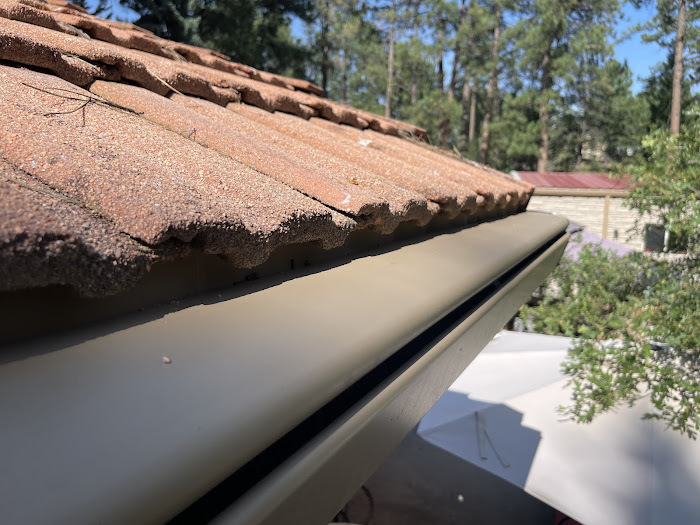
Attachment: the first question to ask about gutter guards for metal roofs
On a metal roof, how a gutter guard product attaches matters more than what the screen is made of.
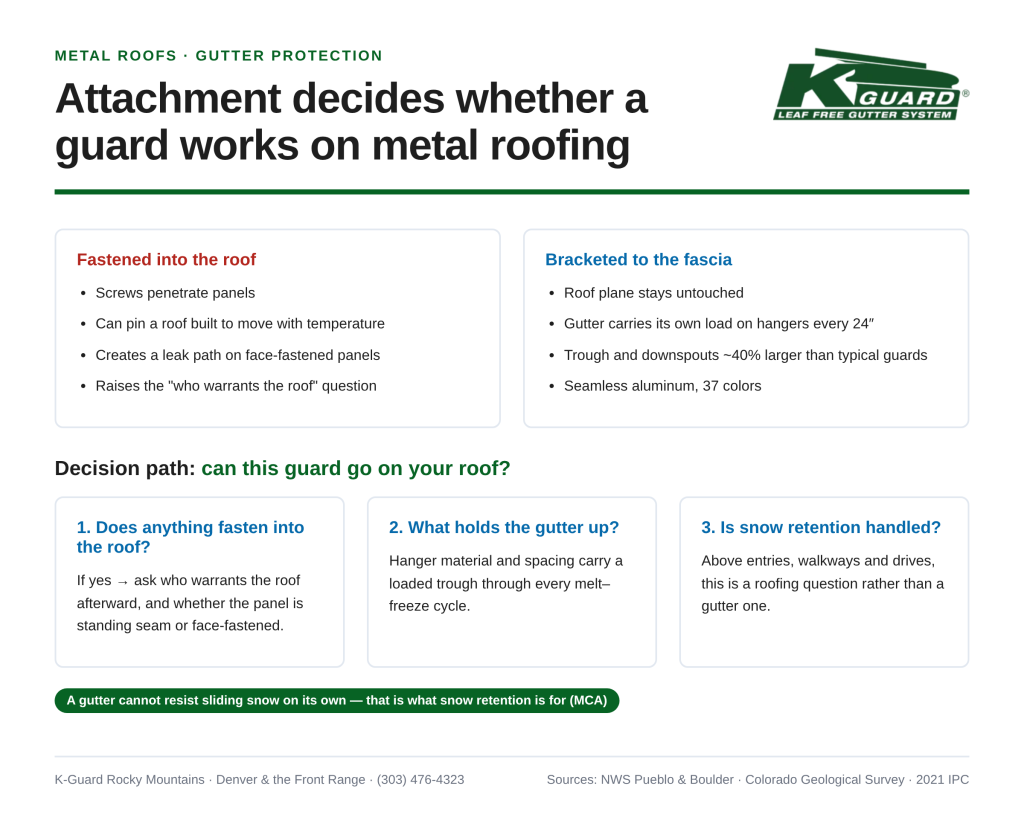
Industry practice for mounting anything to standing seam is to clamp onto the seam rather than fasten through the panel. Seam clamps carry load without actually penetrating the roof (Metal Construction News, Selecting Standing Seam Roof Clamps). MCA also advises mechanical attachment over glue. Plastic components do not align with the service life of the roofing, and 300-series stainless steel hardware is compatible with all roof materials (Metal Construction News, Installing Snow Guards).
That rules out a whole category of gutter cover. Any product screwed under the first course of a panel, or wedged beneath a seam, is fighting the roof. A K-style gutter with a screen dropped in is the most common version of that mistake.
| Guard type | How it mounts | Fit with metal roofing |
|---|---|---|
| Drop-in mesh or screen gutter cover | Sits in the trough, sometimes under panel edge | Poor if it requires lifting or fastening panels |
| Foam or brush inserts | Sits inside the trough | No roof attachment, but fills with grit and needle debris |
| Roof-fastened micro-mesh, including stainless steel mesh | Screwed through or under roofing | Risks penetration and pinning on standing seam |
| Solid gutter hood on independent hangers | Bracketed to the fascia, not to the roof | Keeps the roof plane untouched |
The K-Guard Leaf Free Gutter System belongs in the last row: a one-piece hooded gutter carried on patented all-weather polymer hangers spaced every 24 inches, fastened at the fascia rather than into the roof panel.
Capacity: metal roofing delivers water faster
A slick panel surface moves runoff to the eave quicker than a rough shingle field, so peak flow at the gutter is actually higher. Colorado’s adopted 2021 plumbing code sizes drainage from a 100-year, one-hour rainfall rate. In Denver that rate is 2.4 inches per hour. Horizontal gutters must be sized by flow rate against a capacity table, not chosen out of habit (2021 IPC Chapter 11, Colorado; Appendix B).
Two practical consequences:
- More downspouts, not just bigger trough. Long runs on metal roofing need drops where the water actually arrives.
- Bigger trough helps at the peak. K-Guard’s troughs and downspouts are about 40 percent larger than typical guards. That is capacity you use during the twenty minutes of a Front Range cloudburst.
Stone-coated steel and corrugated roofs
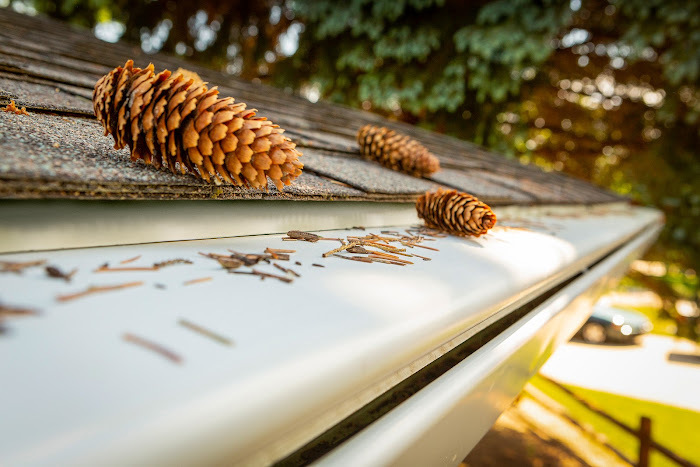
Stone-coated steel panels have a textured granule surface, so snow releases less abruptly than on smooth standing seam. The panel profile is still an important consideration. Corrugated metal and exposed-fastener ribbed roofs are face-attached systems. MCA’s rule is that accessories on face-fastened roofs are mechanically attached through the panel into the structure, with sealants matched to the roof’s own chemistry (MCA). That is a roofing detail, and getting it wrong creates a leak path.
A fascia-mounted hooded gutter sidesteps the whole issue. The roof stays sealed, and the gutter carries its own load.
What to check before you buy
- Does anything fasten into the roof? If yes, ask who warrants the roof afterward.
- What are the hangers made of, and how far apart? Spacing is key to holding a loaded gutter through a melt-freeze cycle.
- Is snow retention part of the plan? On a steep roof above an entry or walkway, that is a roofing question worth asking a roofer, not only a gutter company.
- Is trough capacity matched to the roof area? Ask how many downspouts and why.
- Is the trough seamless? Joints in a sectional run separate first under thermal movement.
- What is covered in writing, and does coverage transfer with the home?
FAQ
Q: Do gutter guards work on a standing seam metal roof? A: Yes, if the system does not depend on fastening into the roof panel. Standing seam is designed to move with temperature change, and industry practice for rooftop accessories is non-penetrating seam clamps rather than screws through panels (Metal Construction News). A hooded gutter carried on fascia-mounted hangers leaves the roof plane alone.
Q: Will a gutter guard stop snow from sliding off my metal roof? A: No. That is what snow retention systems are for, and MCA notes that an unprotected gutter cannot resist sliding ice and snow (MCA). Talk to a roofer about snow retention above doorways, walkways, and driveways.
Q: Are gutter guards for metal roofs different from guards for shingle roofs? A: The trough and hood can be the same; the attachment method is what changes. On shingle roofs many products slide under the first course, which is not an option most metal roofs allow without creating a penetration or a pinned panel.
Q: What about pine needles and cottonwood on metal roofing? A: Debris still reaches the gutter, and it slides down steel panels more readily than shingles. A hooded design that keeps the trough covered handles that better than a screen that debris can sit on.
Q: Do I need bigger gutters with metal roofing? A: Often the honest answer is more downspouts rather than a wider trough. Colorado’s adopted plumbing code sizes gutters by flow rate against a 2.4 inch-per-hour design rainfall in Denver (2021 IPC), and a smooth metal surface delivers that flow to the eave quickly.
Q: Will installing gutters void a metal roofing warranty? A: It depends entirely on whether the installation penetrates the roof. Systems mounted to the fascia do not touch the roof assembly. Ask any contractor, in writing, what they fasten into.
Get a system sized for your home
K-Guard Rocky Mountains installs the K-Guard Leaf Free Gutter System across Denver and the Front Range. The trough is seamless heavy-duty non-corrosive aluminum, formed on site, in 37 colors. On steel panels that means protection for the fascia and foundation, and curb appeal that matches the roofline, without a single fastener in your roof panels. Compare designs on the gutter guard comparison page, see where we work, or request pricing for your home.