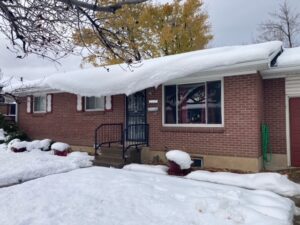

In Colorado Gutters Aren’t Optional
You’ve probably driven past homes without gutters. Maybe you’ve wondered if yours actually needs them. The short answer: unless your home fits into a rare combination of sandy soil, wide roof overhangs, and perfect grading, skipping gutters is a decision that costs you money.
Especially in Colorado, where our soil is prone to expanding when wet and our weather can swing wildly in a single day. Spring snowmelt dumps thousands of gallons off your roof in weeks. Summer monsoons hit hard and fast. Without a system to control where that water goes, it goes everywhere — and everywhere includes the worst possible place: your foundation.
What Happens When Water Falls Off Your Roof
Think about physics for a moment. A standard Denver-area roof sheds roughly 600 gallons of water for every inch of rain that falls. That’s not a slow drip. During a typical spring storm, that volume hits the ground in under an hour.
Without gutters, that water lands in a concentrated line around your home’s perimeter. It saturates the soil directly against your foundation. It erodes the grading. And if your soil has any clay content — which most Colorado Front Range soils do — it expands when wet and contracts when dry, creating pressure cycles that crack foundations.
Foundation repairs in the Denver area start around $4,000 for minor crack sealing. Structural repairs run $10,000 to $30,000 or more. Compare that to the one-time cost of a gutter system, and the math is not subtle.
The Exceptions Are Rare
There are homes that can function without gutters, but they meet very specific conditions; roof overhangs of at least two feet on all sides, soil that drains instantly — pure sand or gravel, not our typical clay-heavy Colorado dirt, landscape grading that slopes sharply away from the foundation with no low spots. And even then, you’re gambling on erosion, basement seepage, and staining on your siding.
Most Colorado homes were built with standard 12-to-18-inch overhangs and typical lot grading. Those homes need gutters. The builders knew it when they installed them originally. If yours are missing now, it’s because someone removed them — not because the home was designed to go without.
What the Evidence Says About Foundation Water Damage
The concrete facts: 90% of basement water problems trace back to poor exterior water management. That’s not a gutter company talking point — that’s data from foundation repair specialists who see the aftermath.
Colorado’s freeze-thaw cycles make this worse. Water that pools against your foundation in October freezes in November. Ice expands. Concrete cracks. By spring, you have new entry points for the snowmelt you’re about to get hit with. The damage compounds every year you wait.
Insurance companies see this pattern clearly enough that many policies explicitly exclude foundation damage caused by “long-term water intrusion” or “lack of maintenance.” Translation: if your gutters failed and you didn’t address it, you’re paying for the repair yourself. Learn more about foundation damage in this blog.
What About Homes With Gutters That Don’t Work?
Having gutters on your home is half the battle. Maintaining those gutters is the rest of the fight. Gutters clog, overflow, or pull away from the fascia during heavy weather. A clogged gutter is worse than no gutter at all because it concentrates water at specific failure points. Instead of spreading the water around the foundation of your home, now water is dumping from a single failure point, exactly where you don’t want it.
Standard gutters require cleaning two to four times per year in Colorado. Spring brings cottonwood seeds that mat into wet clumps. Fall brings pine needles and sap as well as leaves from mature trees. Miss one cleaning cycle and you’re risking overflow during the next storm.
This is where homeowners start asking whether the maintenance is worth it. The answer depends on what system you’re maintaining. Builder-grade gutters are too small to handle the volume of water our homes see in a single summer storm. DIY gutter guards create new problems such as freezing in winter, they trap debris on top instead of inside, and they rarely handle Colorado’s heavy snow loads.
What Gutter System Actually Works in Colorado?
If you’re going to install gutters — and you should — install a system designed to handle weather, not just collect it. You need capacity for high-volume runoff during spring melt and summer storms. You need a design that keeps debris out without creating ice dam risks. And you need something you’re not climbing a ladder to maintain when you’re 70.
Standard 4-inch gutters are undersized for Colorado weather. Upgrading to 5-inch or 6-inch K-style gutters increases capacity significantly. Pairing that with a solid hood system — not mesh or foam inserts, but a curved hood that uses water tension to channel flow while blocking debris — eliminates the maintenance cycle entirely.
How To Determine Your Home’s Gutter Needs:
- Check your foundation perimeter after the next heavy rain. Look for erosion, pooling water, or soil washout. If you see any of these, you have a drainage problem that proper gutters would solve. Here’s another article that talks more about what to look for when evaluating your foundation.
- Inspect your existing gutters for sag, rust, or separation from the fascia. These are signs your current system is failing and needs replacement, not just repair.
- Calculate what you’re spending on gutter cleaning annually. Multiply what you spend per cleaning ($200 is the average cost) by 2-3 cleanings per year. That’s your maintenance baseline — money you’re spending to keep an inadequate system limping along.
- Look at your basement or crawl space walls for water stains or efflorescence. White chalky deposits on concrete mean water has been getting through. Catching this early saves major repair costs.
- Consider your age and how long you plan to stay in your home. If you’re not climbing ladders anymore, maintenance-free systems aren’t a luxury — they’re a practical necessity.
The K-Guard Rocky Mountains Perspective
We’ve installed gutters on homes that have never had them, and replaced systems that failed years ago but kept getting “fixed” with temporary patches. The pattern is consistent: homeowners who wait pay more in the long run — in repairs, in maintenance contracts, or in resale value lost to visible foundation issues. Our patented hood system handles Colorado’s weather extremes without clogging, which is why we back it with a lifetime transferable warranty. It’s not the cheapest option, but it’s the last gutter system your home will need.
K-Guard Rocky Mountain installs a permanent, maintenance-free gutter system built for Colorado homes. If you’re ready to stop climbing that ladder, schedule a free quote today. Need more information? Check out this FAQ about K-Guard.