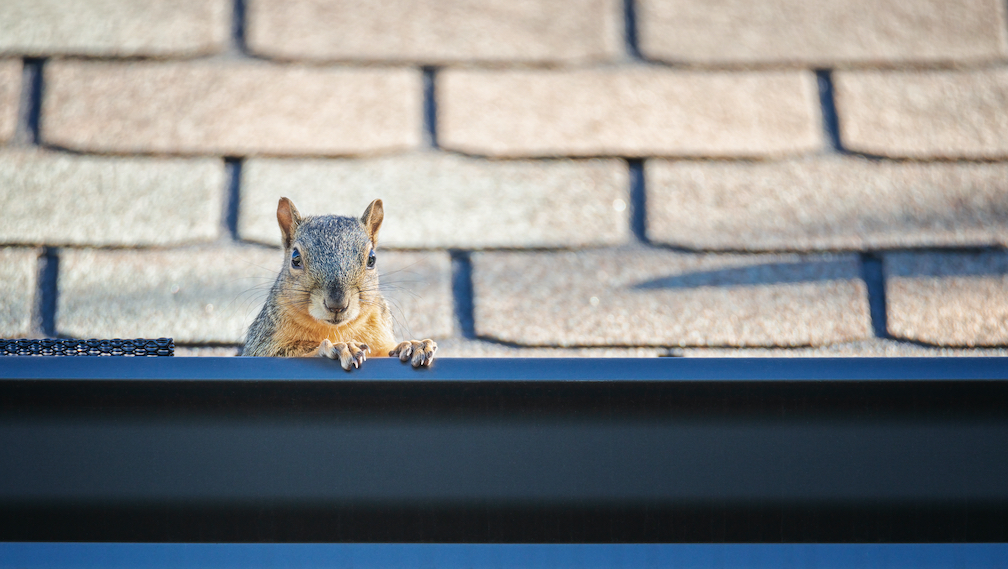
Squirrels Love Gutters
You’ve seen them. Gray blurs racing along your roofline at dawn, launching themselves across gaps, treating your gutters like their personal interstate highway. If you’ve got trees anywhere near your house, you’ve probably got squirrels using your gutters as a runway, nesting spot, or both. And if you think it’s just a nuisance, think again — squirrels chewing on gutters, through fascia boards, nesting in downspouts, and clogging your drainage system can cause thousands of dollars in water damage before you even realize there’s a problem.
The question homeowners ask us most often isn’t whether squirrels are in their gutters — it’s whether there’s a gutter system that actually keeps them out. The short answer: yes, but not all guards work the same, and most of the products you see at home improvement stores won’t solve the problem.
Standard Gutters Are a Wildlife Magnet
Standard open gutters are an invitation. They collect leaves, pine needles, and cottonwood debris — exactly the kind of material squirrels and birds use to build nests. The horizontal channel gives them a protected travel route between trees and entry points on your roof. And once they’re in, they’re persistent. Squirrels can chew through aluminum, plastic mesh, and even some types of vinyl gutter guards when they’re motivated enough.
In Colorado, this becomes a year-round issue. Spring and fall are peak nesting seasons. During winter, squirrels look for sheltered spaces to store food and escape the cold. Your gutters, especially if they’re clogged with organic material, offer everything they need. Add in the fact that pine trees and cottonwoods are everywhere from Aurora to the foothills, and you’ve got a perfect setup for an ongoing problem.
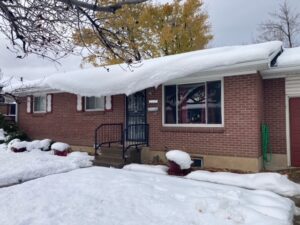
The damage isn’t always obvious at first. Squirrels chew fascia boards to widen entry points. They pack downspouts with nesting material, blocking water flow. When spring snowmelt or a heavy rainstorm hits, that water has nowhere to go — so it overflows the gutter, soaking your fascia, soffit, and eventually your foundation. By the time you notice the staining or rot, the repair bill is well into four figures.
What the Evidence Says About Gutter Guards and Wildlife
Most homeowners assume any gutter guard will keep animals out. That’s not true. Mesh guards, foam inserts, and perforated toppers can all be compromised by determined squirrels. Mesh guards in particular give squirrels something to grip — and once they find a seam or edge, they’ll work at it until they create an opening. Foam inserts decompose over time, especially under our extreme UV exposure and freeze-thaw cycles, leaving gaps that become nesting opportunities.
The other issue is debris accumulation on top of guards. If leaves and pine needles pile up on a mesh or screen system, you’ve just created a squirrel buffet. They’ll tear through the guard material to get at the organic matter underneath, or they’ll simply nest on top of the guard itself, blocking water flow in the process.
Colorado homeowners still reported squirrel or bird nesting activity in or around their gutters despite having mesh guards. The guards slowed the animals down, but didn’t stop them. And in some cases, homeowners reported that guards made the problem worse because once an animal got in, it was harder for the homeowner to clean out the nest without removing the entire guard system.
The key is eliminating both the access point and the reason squirrels are interested in the first place. If there’s no debris to nest in and no easy way to get inside the gutter channel, squirrels move on. They’re opportunistic — they’ll take the path of least resistance, and that’s usually somewhere other than a sealed, smooth-surfaced gutter system.

What is Best at Keeping Squirrels Out
If you want to keep squirrels out of your gutters for good, you need a system designed with three things in mind: no debris accumulation, no accessible seams or edges, and a surface squirrels can’t grip or chew through.
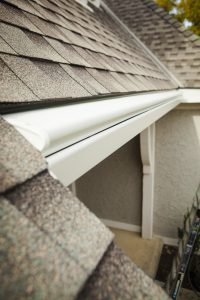
Here’s what that looks like in practice. First, the gutter itself needs to be covered with a solid hood or curved guard that prevents animals from getting inside the channel. This isn’t the same as a mesh screen. It’s a one-piece aluminum cover that sits over the gutter and channels water in while keeping everything else out. Squirrels can’t chew through commercial-grade aluminum, and the smooth, curved surface gives them nothing to grip.
Second, the system needs to be installed in a way that eliminates gaps. If there are seams at the roofline or where sections connect, animals will find them. A professionally installed system with sealed joints and tight integration with your roofline leaves no entry points.
Third, the system has to handle debris without creating a nesting opportunity. This means shedding leaves and needles off the surface rather than trapping them on top. A curved hood design does this naturally — debris slides off during rain or wind, rather than piling up and attracting animals.
Trimming tree branches away from your roofline helps, and should likely be employed as part of your solution. But squirrels can jump six to eight feet horizontally, and they’re excellent climbers. Unless you’re willing to remove every tree within twenty feet of your house — which most homeowners aren’t — you need a gutter system that’s squirrel-proof by design.
Next Steps for Keeping Squirrels Out of Your Gutters
- Inspect your current gutters for signs of animal activity. Look for chew marks on fascia boards, nesting material in downspouts, or droppings along the roofline. If squirrels are already nesting, you’ll need to remove the nest and repair any damage before installing a new system. Inspecting your gutters regularly is highly recommended. This inspection guide may help.
- Evaluate your current gutter guards. If you have mesh, foam, or perforated guards and you’re still seeing squirrel activity, those guards aren’t doing the job. Replacing them with a solid-hood system eliminates the problem at the source.
- Check your downspouts. Animals often pack nesting material into downspouts, especially if the opening is accessible from the roofline. Make sure water is flowing freely before installing a new guard system.
- Look for entry points beyond the gutters. Squirrels often use gutters as a highway to access attics, soffits, or roof vents. Seal those entry points with metal flashing or steel mesh — not wood or plastic, which squirrels can chew through.
- Install a gutter system designed to exclude wildlife. A sealed, smooth-surfaced system with a curved aluminum hood eliminates both the access and the attractant. Once debris stops accumulating and squirrels can’t get inside, they’ll find somewhere else to spend time.
The K-Guard Rocky Mountains Perspective
K-Guard’s hooded system deters many of the pests we find in Colorado. The curved aluminum hood has no seams for squirrels to exploit, and the smooth surface gives them nothing to grip. Debris sheds off naturally, so there’s no nesting material to attract them in the first place. We’ve had customers tell us they haven’t seen a squirrel on their roofline in years after installation — not because the squirrels left the neighborhood, but because the highway closed.
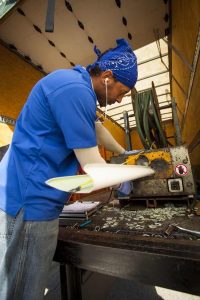
K-Guard Rocky Mountain installs a permanent, maintenance-free gutter system built for Colorado homes. If you’re ready to stop sharing your roofline with the local wildlife, schedule a free quote today.